

Whether it’s a short hop across the Channel or an overland expedition to the furthest reaches of Europe, some of the richest travel experiences happen when you skip the flight.
Today, it’s easier to travel further and faster around Europe than ever before — to board a flight and effectively parachute yourself into a new destination. But by travelling overland, be it by ferry, train or car, on a bike or on foot, you’re able to observe the slow, subtle changes at ground level with every accumulated mile.
Overland travel by rail is also easier than it’s ever been, thanks to an ever-expanding network of high-speed and sleeper trains across Europe. You might board a morning Eurostar at London St Pancras International and that same day be joining a midnight crawl of Madrid’s tapas bars or standing beneath Milan’s hulking Duomo as stars twinkle above its white marble facade.
Ferries, too, offer perspectives unfamiliar to those at the cruising altitude of an airliner, whether that’s witnessing the green coast of northern Spain unravelling out of the blue horizons of Biscay or seeing Icelandic volcanoes peek over grey North Atlantic waves.
For an easy weekend on the continent, there are plenty of alternatives to the classic European city break.
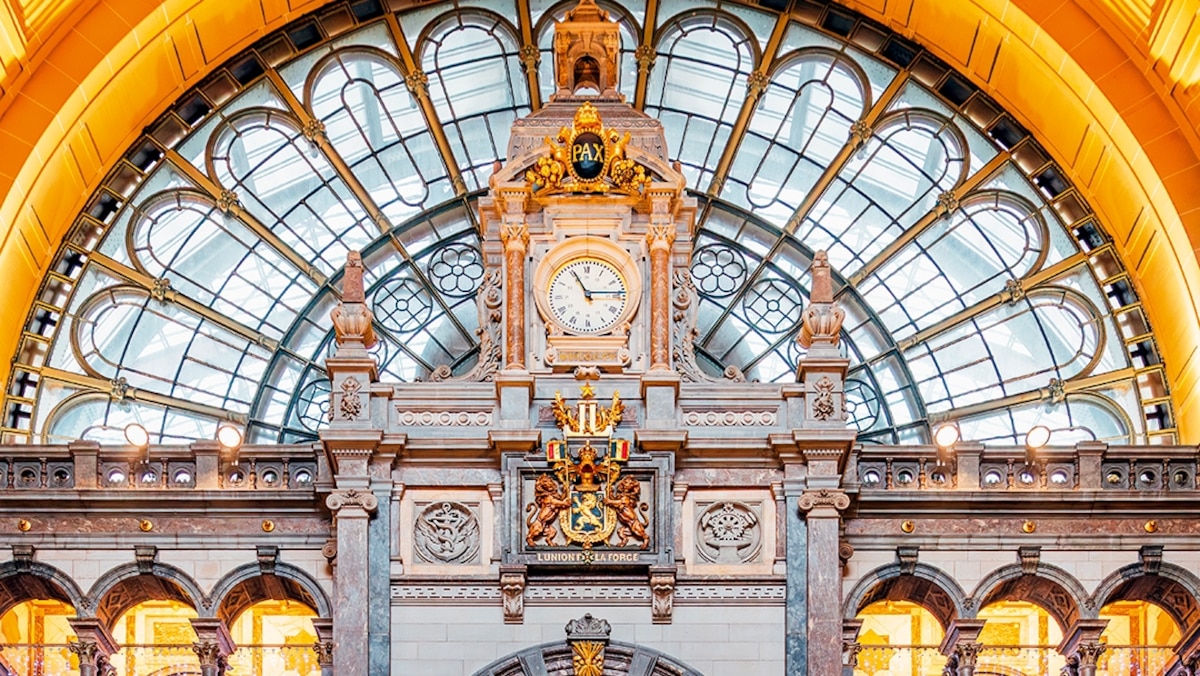
One of the fanciest buildings in Antwerp is the first one you encounter: Antwerpen Centraal station, with its Beaux Arts details, is a true cathedral of the rails. It’s a grand introduction to Belgium’s second city, at once a busy port, diamond trading centre and hometown of great artists. You’ll want to call into the city’s actual cathedral, adorned with works by Rubens. Otherwise, spend your time exploring the revitalised port district and the lively old town, in whose bars you can sample robust Belgian beers, including those from the city’s beloved De Koninck brewery.
Less than an hour from landfall at Calais, the seaside resort of Le Touquet was marketed as ‘Paris Plage’ (Paris beach) in the late 19th century: a place for well-heeled capital dwellers to stroll newly planted pine forests and roll dice in glamorous casinos. Today, you can catch echoes of this Belle Époque heydey while strolling past Anglo-Norman hotels of faded elegance and exploring the Saturday market, fragrant with fresh seafood and pongy cheese. The ace in Le Touquet’s pack is its seven-mile-long beach, perfectly oriented to catch the last rays of sunset.
Millions of visitors make their way to Amsterdam to coo at its maze of canals, marvel at Golden Age treasures and ride Dutch bikes over juddering cobbles. Far fewer make their way to nearby Utrecht, which contains all those same ingredients, albeit on a smaller scale. Less than half an hour’s train ride from the Eurostar terminus at Amsterdam Centraal, it makes for a fine alternative for a weekend away.
Upon arrival, get your bearings by climbing the Domtoren, the tallest church tower in the Netherlands, from whose pigeon-pecked heights you have a view over the tangle of Utrecht’s medieval city. Descend to trace the Oudegracht, or ‘old canal’, which meanders waywardly amid step-gabled townhouses, its banks lined with restaurants that spill out on balmy nights. Hire a bike to make a 45-minute cycle detour to De Haar Castle, a turretted pile that looks like a Loire chateau lost in the Low Countries.
Many passengers boarding the Eurostar in London are beelining straight for Paris, but it’s worth disembarking a stop early, in Lille. There’s plenty to do to fill the time saved. You might start at the sprawling Grand Place, the square at the heart of the city, overlooked by the mercantile majesty of the Vieille Bourse — the palatial former stock exchange. Close by is one of France’s oldest and best museums, the Palais des Beaux Arts, first opened at the decree of Napoleon Bonaparte and still rousing the masses with works by masters such as Raphael, El Greco and Rubens.
Flush to the Belgian border, Lille sits at a culinary crossroads: beery beef stews and stuffed waffles see Flemish stodge meet Gallic elan on restaurant menus. Walk it all off with a stroll around the Citadel of Lille, its hulking 17th-century battlements now encircled by parkland and besieged only by dog walkers and Sunday strollers.
With four days to fill, it’s possible to make more ambitious plans — fitting in Dutch islands, Irish mountains or French fishing villages.
There’s something about Berlin that lends itself to arrival by sleeper: you might imagine yourself a character in a John le Carré novel as your train creaks past grey tower blocks and over the long-vanished East-West border. Getting to the German capital from the UK has become much easier thanks to the new European Sleeper night train from Brussels — a good excuse for a short Cold-War-themed trip.
Popular spots such as Checkpoint Charlie and the East Side Gallery are worth a visit, but be sure to head for more offbeat attractions, too. Tempelhofer Feld, once an airfield where planes landed during the Berlin Airlift, has become a park where you can book kite landboarding lessons on the old runway. Equally fascinating is Teufelsberg, an Allied listening station from the Cold War, fully repurposed as a concrete canvas for street art.
Finish off with a standup paddleboarding jaunt down the Spree; the waterway was once a heavily guarded no-man’s land between East and West Berlin, but is now patrolled only by puttering pleasure boats and quacking ducks.
For many, Luxembourg means Luxembourg City — the unassuming capital, known for its low taxes — but that’s only part of the story. Beyond it lies the rest of the Grand Duchy, an unsung hinterland set an equally untaxing drive away from the Calais ferries and perfectly sized for a four-day escape. Start by making for the great fortification at Vianden, a hulking castle of Romanesque towers rising over the wooded hills of the Ardennes. Then press on to little Mullerthal, where forest trails enter some of the most stirring scenery in Benelux, shimmying through sandstone gorges and accessing secluded waterfalls.
Toast your Luxembourg circuit in the Moselle Valley, the country’s wine heartland, in whose tasting rooms you might try local riesling and cremant, a regional alternative to champagne.
A long arm protruding into the Channel, Normandy’s Cotentin Peninsula is more than deserving of a visit, thanks to its soaring sea cliffs, expansive beaches and pretty towns. The port of Cherbourg makes for a worthy pit stop en route, with its handsome old town and a fine maritime museum right by the dock. Press on to find picturesque fishing villages such as sleepy Barfleur — a one-time Viking port — and Saint-Vaast-la-Hougue, its marinas guarded by 17th-century fortifications.
For the wilder side of Cotentin, make for the Nez de Jobourg promontory, where craggy cliffs tower over breaking waves and the Channel Islands appear as a hazy silhouette on the western horizon.
The Wicklow Mountains are a cluster of glacier-gouged peaks that begin on the southern edge of Dublin; to venture in among them is to delve into Irish history. For British travellers, they’re also close enough for a short break via the Holyhead ferry in Wales. Head to the Powerscourt Estate, whose manicured formal gardens stand in contrast to the wild summits beyond, before taking a road trip up Sally Gap, where a historic British military road winds spectacularly across desolate moorlands.
Conclude by spending time at Glendalough, the sweeping valley where the sixth-century Saint Kevin lived as a hermit, its monastic ruins in harmony with the wooded hills around.
In the wildest and least inhabited corner of the Netherlands, the coast fractures into a complex jigsaw of islands, estuaries and salt marshes — and a similarly intricate web of cycle lanes runs beside the water. A fine base for a Zeeland bike trip is the provincial capital of Middelburg, a charming town credited as the birthplace of both the microscope and the telescope. In a full day you can complete the 35-mile Rondje Walcheren, a flat and easy loop exploring the windswept dunes and beaches of Walcheren peninsula.
For something shorter, make the hop to Veere, a picturesque town presided over by a 14th-century church.
With time to delve deeper, you could head to Atlantic France to slurp oysters or ride the rails through the Alps to Italy.
The Île de Ré and Île d’Oléron are two of France’s great holiday islands. These baguette-shaped landmasses are synonymous with fishing villages, horizon-hugging beaches and oysters, which are prized for their salty, mineral terroir in the manner of revered wines.
Make an oyster pilgrimage by catching a ferry to Saint-Malo and then driving to La Rochelle, where a road bridge swoops across a dazzling strait to the Île de Ré. This is the more famous of the two islands, with picturesque cottage gardens of hollyhocks and lavender, seafood restaurants serving steaming buckets of moules (mussels) and rustic roadside stops advertising huitres (oysters). Among the best is Cabane du Boutillon near Ars-en-Ré.
An hour-and-a-half drive to the south, the Île d’Oléron feels different: rather like an oyster, it requires care to prise open and fully appreciate its charms. Its appeal is in its wildness: the beaches are longer, dunes loftier and visitors fewer. Drive to the striped Phare de Chassiron lighthouse to see the Atlantic dashing against pebbly beaches.
It’s possible to travel from London to Milan in a single day via Paris, with the fast TGV train from there rendering the passing landscapes an incomprehensible blur. But if you have more time, another railway detour unfurls through Switzerland. The mountain scenery rolls past more slowly, giving you time to fully digest its splendour. From Paris, board an express service to Zurich, stay the night in the pretty lakeside city then hop on a local train to Chur.
From here, scarlet-hued Bernina Express trains swerve and slalom their way through the Swiss mountains, climbing to elevations in excess of 2,200 metres and briefly entering the realm of glaciers and mountain goats.
Upon descending, the Italian border town of Tirano makes a worthwhile stopove