

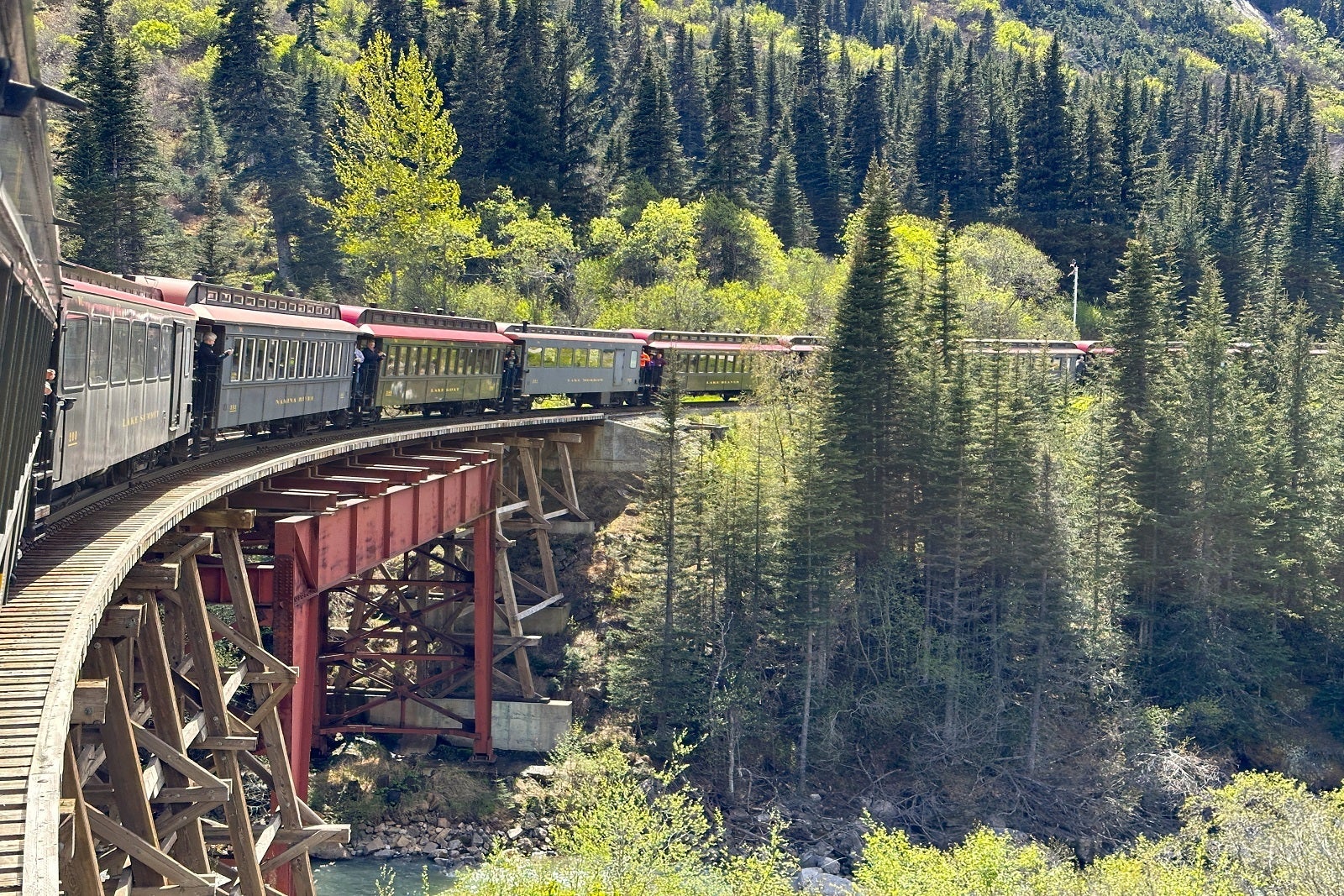
The White Pass and Yukon Route Railway offers a unique Alaska cruise and train experience in Skagway, combining history, nature, and trains.
Even if trains, history and nature aren't your cup of tea on their own, something absurdly special happens when the three combine for an Alaska cruise and train experience in Skagway.
The White Pass and Yukon Route Railway is a staple of any visit to Skagway, Alaska, particularly if you arrive by ship during an Alaska cruise. The town's success is closely linked to the development of the railroad infrastructure, as the train line has carried passengers and cargo between Alaska and Canada for 125 years.
When I rode the Skagway train's White Pass Summit route, the experience was fascinating and exhilarating. It offered a narrated history lesson and views that are still absolutely unrivaled by those on any other train journey I've experienced.
From how it started to where the route will take you and how much you'll pay for tickets, here's what you can expect from a ride on the White Pass Railway, Skagway's most scenic route to Canada.
Construction on the White Pass train, Skagway's easiest way in and out during the gold rush days of the early 1900s, began in 1898. Investors from the U.S., Canada and England — along with more than 35,000 workers — came together to complete the $10 million project in just two years.
Until the tracks were laid, the two main routes over the mountain were the shorter but steeper Chilkoot Trail and the longer but flatter White Pass. Both presented rough terrain and brutal conditions for anyone who made the trek.
Each person who ventured out in search of gold via one of the two paths was required to carry 1 ton of supplies to see them through their trip, making the hike even more treacherous. After the railroad's completion, the expedition was far less arduous, and it took much less time for stampeders to reach the Klondike region.
After more than 80 consecutive years of operation, including during the winter months, the railroad halted service from 1982 to 1988. This was because the cost of metal fell, and the mines that produced most of the train's cargo closed.
In 1988, the route reopened to carry tourists and now operates from late April to mid-October, aligning with the Alaska cruise season. In 1994, the White Pass and Yukon Route was designated a Historic Civil Engineering Landmark, among the likes of the Eiffel Tower and the Statue of Liberty.
Like the mountain over which the locomotives run, the cost to ride the Skagway train along the most popular White Pass Summit route is steep. Tickets purchased online at least 24 hours in advance are $155 per adult and $77.50 per child for the two- to three-hour trip. It takes passengers 20 miles from Skagway to an elevation of nearly 3,000 feet, then turns around at the Canadian border and heads back.
A version of this tour, on more limited-capacity vintage parlor cars pulled by a steam engine dating to 1947, costs $249 per adult and $180 per child.
For cruise passengers with extra time in Skagway, the longer Bennett Scenic Journey route travels about 68 miles to Carcross in Canada's Yukon Territory, with a return along the Klondike Highway by bus (or vice versa). The cost for this eight-hour journey is $289 per adult and $144.50 per child and includes a 45-minute stop in Bennett, British Columbia, as well as a boxed lunch served on the train.
Passengers on this route will need to bring a passport as the train will pass into Canada from the U.S. You do not need a passport on the White Pass Summit route.
The White Pass and Yukon Route Railway also sells two hiker service excursions from Skagway, one to the Denver Glacier trailhead and the other to the Laughton Glacier trail. These include round-trip rail transportation with time built in for self-guided hiking. Tickets cost $60 per adult ($30 per child) for the shorter Denver trip and $106 per adult ($53 per child) for the longer Laughton journey. These also require passports
Non-cruise passengers can also purchase tickets for options such as one-way train rides, camping and bus-train combos.