

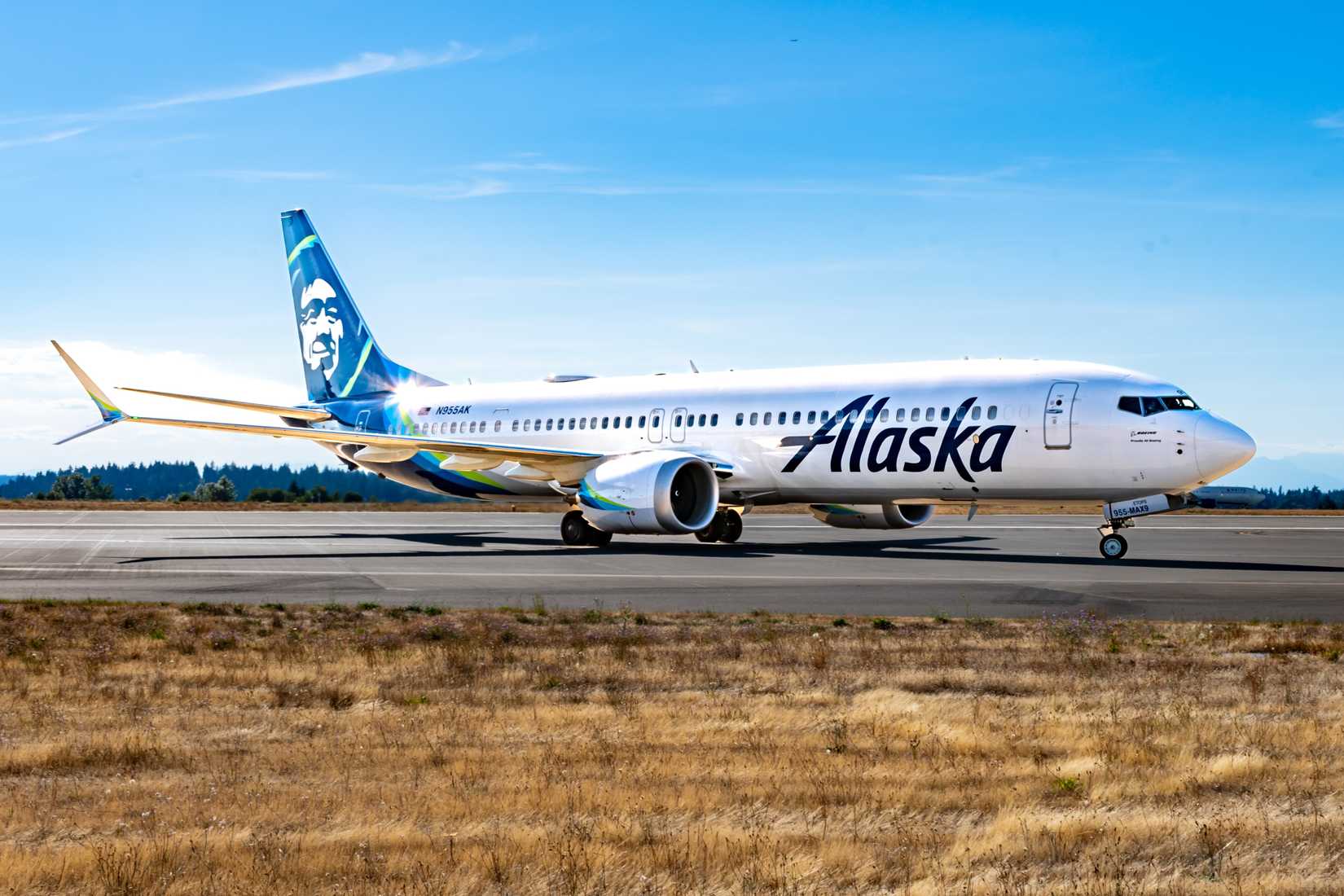
From spacious seats and premium dining to Starlink Wi-Fi and lounge access, Alaska Airlines is redefining domestic First Class.
Alaska Airlines is making a significant push into premium travel, investing in new First Class seating, faster in-flight connectivity, improved dining, and expanded airport lounges. The Wall Street Journal reports that the Seattle-based carrier is making a concerted effort to position itself to capture more high-paying passengers, particularly as its competitors continue upgrading their own premium products.
Alaska Airlines' investments also come as its integration with Hawaiian Airlines creates new opportunities across domestic and international markets. The airline's ambitions extend beyond conventional domestic First Class. Its expanding premium seating capacity, Starlink Wi-Fi rollout, and plans to introduce lie-flat suites aboard future Boeing 737 MAX 10 aircraft signal a broader transformation.
Alaska Airlines offers complimentary lounge access on qualifying paid or award First Class itineraries with a flight of at least 2,000 miles (3,219 km). This is especially useful for those on transcontinental flights to/from its West Coast bases, flights to/from Hawaii, as well as most flights to/from Anchorage International Airport (ANC).
Even if the flight length doesn't qualify, passengers on shorter flights can generally purchase a discounted single-entry pass for $35, subject to availability. This policy is particularly generous compared with the Big Three domestic airlines, which generally exclude ordinary domestic First Class passengers from lounges unless they hold a qualifying credit card or have paid for lounge access.
Free lounge access on paid or award tickets with a flight of at least 2,000 miles
Delta One passengers qualify, including domestic Delta One services
Qualifying United Business/Polaris transcontinental and Hawaii services
Flagship First and Business on designated transcontinental and Hawaii routes
However, it is worth noting that Alaska Airlines passengers upgraded to First Class, whether complimentary or paid, are excluded from automatic access to lounges. While this lounge access policy is a clear competitive advantage, it operates across a relatively small lounge network compared to the larger airlines.
Alaska Airlines currently operates three lounges at its primary base at Seattle-Tacoma International Airport (SEA), as well as additional lounges at Portland, Anchorage, Los Angeles, and San Francisco. All offer extensive dining options, complimentary refreshments, alcoholic beverages, and comfortable workspaces.
However, the airline is investing heavily in upgrading and expanding its lounge offering. It is planning a major new Seattle facility opening in late 2027, featuring a 500-seat Alaska Airlines Lounge and separate 200-seat Aurora Lounge within a nearly 41,000-square-foot complex. It also has new lounges arriving at San Diego International Airport (SAN) and Honolulu International Airport (HNL) in early 2028.
Alaska Airlines' Atmos Rewards program, introduced alongside Hawaiian Airlines in 2025, offers a distinctive alternative to the Big Three's loyalty schemes. From January 2027, members can earn points and status based on distance flown, ticket spending, or flight segments, with their preferred method selectable from October 2026.
This industry-first flexibility particularly benefits travelers purchasing more expensive First Class tickets or frequently flying shorter routes. The program also makes premium cabins more accessible through complimentary upgrades. All four elite tiers qualify for space-available First Class upgrades on eligible Alaska Airlines flights, with benefits extending to Hawaiian's North American network.
The Points Guy notes that Atmos Titanium members and a companion can even receive day-of-departure upgrades to international lie-flat business class on eligible flights, without using points or certificates. This is a particularly unusual benefit among major US airline loyalty programs.
Therefore, unlike the Big Three, which largely emphasize ticket spending in their loyalty qualification systems, Alaska Airlines gives members greater control over how they earn status. Nevertheless, upgrades remain subject to availability, and elite members compete for seats that airlines increasingly prefer to sell. Atmos Rewards therefore offers genuine flexibility that isn't available elsewhere in the market, but it isn't a guaranteed route into First Class.
Alaska Airlines' food and beverage program offers a more distinctive proposition. Its Chef's (tray) Table initiative, introduced in 2025, features rotating menus from celebrated West Coast chefs, beginning with James Beard Award-winner Brady Ishiwata Williams of Seattle's Tomo restaurant.
The program builds on an earlier collaboration with San Francisco chef Brandon Jew, whose Cantonese-inspired dishes were subsequently expanded to additional East Coast routes. Alaska Airlines also emphasizes regional drinks, including specialty coffee, craft beer, and Pacific Northwest wines.
First Class passengers can also pre-order meals between two weeks and 20 hours before departure, with meal options available on eligible flights as short as 670 miles (1,078 km). Menus have featured dishes such as mochi waffles with fried chicken, glazed short ribs, and buckwheat soba with ahi tuna. Availability depends on the route and departure time.
Mark Krolick, the carrier's Managing Director of Inflight Product & Experience, has noted the importance of choosing food and wines that reflect the unique cultures of the markets that Alaska Airlines calls home. He says that:
"Exceptional dining is an essential part of the premium travel experience and our fall menu brings together the talent and distinct culinary perspectives of chefs in Seattle and Honolulu, with thoughtfully crafted dishes that celebrate the flavors of our home communities while bringing a fresh perspective to dining at 35,000 feet.”
Delta, United, and American also provide complimentary First Class meals on qualifying longer flights, with varying pre-order options. Therefore, Alaska Airlines is choosing regional culinary partnerships as a path to greater differentiation, and its strength comes through building a distinctive culinary identity. However, it is worth noting that the most elaborate chef-designed dishes are concentrated on selected routes, while shorter flights receive simpler service.
Alaska Airlines is also transforming its onboard connectivity through Starlink, SpaceX's low-Earth-orbit satellite network. Compared with traditional geostationary satellite systems, Starlink offers lower latency, supporting smoother video calls, streaming, gaming, and everyday browsing.
Connectivity is complimentary for Atmos Rewards members on equipped aircraft, regardless of cabin, but is a particularly important benefit for the business travelers that make up the majority of First Class seats. The current rollout puts Alaska Airlines among the leading US adopters of next-generation inflight WiFi.
40% equipped as of September 25; regional E175 and Hawaiian A330/A321neo installations complete
43% equipped as of October 15; more than 635 aircraft
Starlink, alongside existing satellite systems
Large-scale installations scheduled to begin in 2027
Initial installations underway in 2026; wider rollout planned for 2027
Existing satellite systems; future Amazon Leo
Amazon Leo installations planned from 2028
By Fall 2026, more than 40% of the combined Alaska–Hawaiian fleet had Starlink, including the full Embraer E175 regional fleet. This broadly matches United Airlines' reported 43% installation rate in mid-October, and places it ahead of American Airlines' planned 2027 installations.
Importantly, Alaska Airlines' rollout is not yet complete: passengers on many Boeing 737s still use older connectivity systems, while United has equipped more aircraft in absolute terms. Nevertheless, Starlink represents a substantial improvement in Alaska Airlines' onboard experience, and the airline is well positioned to offer reliable, high-speed connectivity across its entire fleet by the end of 2027.
Alaska Airlines claims the most generous legroom of any major US carrier's conventional domestic First Class cabin, offering up to 41 inches (104 cm) of seat pitch. This is typically two to four inches more than the traditional First Class recliner seat pitch offered by its principal competitors, and up to five inches (13 cm) more than JetBlue's new BlueFirst seats that launch in December.
Alaska Airlines' newer seats also feature calf rests, adjustable headrests, device holders, and USB-C charging, all very welcome improvements on transcontinental flights. The airline has simultaneously expanded its premium seating capacity. Its Boeing 737-800s gain four First Class seats, increasing capacity from 12 to 16.
Meanwhile, Boeing 737-900ER and Boeing 737 MAX 9 aircraft will receive six additional Premium Class seats. The program is designed to add approximately 1.3 million premium seats annually, creating more capacity for passengers to purchase premium seats and more opportunities for complimentary upgrades. The biggest transformation is still ahead: following the 737 MAX 10's FAA certification in October 2026, Alaska Airlines expects its first delivery in the second quarter of 2027.
From 2028, at least 25 MAX 10s will feature 12 lie-flat Aurora Suites with direct aisle access, 19-inch 4K screens, and wireless charging. These aircraft will enable Alaska Airlines to compete more directly with premium transcontinental products offered by Delta Air Lines, United, and American, marking a significant departure from its traditional domestic recliners.
Found an error? Send it info@simpleflying.com so it can be corrected.