

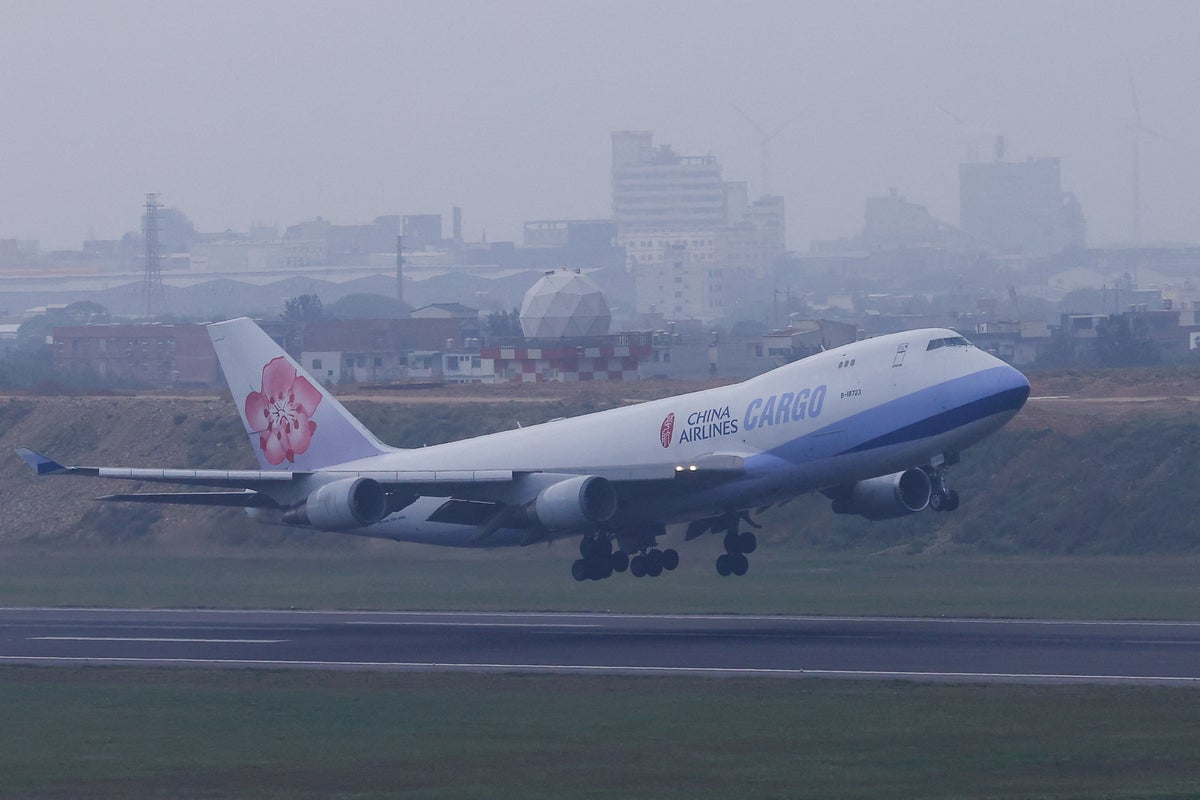
U-turn comes as Taiwan condemns Pakistan's distorted narratives, which consistently follow China's lead
Want to bookmark your favourite articles and stories to read or reference later? Start your Independent Membership today.
Pakistan reversed its decision to close its skies to Taiwanese planes in a dramatic U-turn as Taipei blamed Islamabad for “weaponising airspace”.
The controversy began on Wednesday after it was reported that Pakistan, a close ally and neighbour of China, barred Taiwanese carriers, including China Airlines and EVA Air, from flying through its airspace in support of Beijing’s One China policy.
Pakistan’s defence minister, Khawaja Asif, was quoted by Bloomberg News as saying the decision was consistent with Islamabad’s adherence to the One China policy, under which it recognises Beijing’s position on Taiwan.
“The aviation division follows the One China policy – only mainland China is allowed,” he said. “We have permitted only Chinese airlines to fly over Pakistan.”
Taiwan’s foreign ministry responded sharply, condemning Islamabad for pandering to China and using aviation access as a political tool.
It said it “strongly refutes and condemns Pakistan's distorted narratives, which consistently follow China's lead, disregard international realities, and severely denigrate Taiwan's sovereignty, as well as its remarks politicising and weaponising airspace.”
However, less than 24 hours later Pakistan Civil Aviation Authority (PCAA), which operates under the defence ministry, said it authorised both Taiwanese airlines to use the country’s airspace from Wednesday until 27 March next year.
Two documents dated Wednesday were cited in reports that approved passenger and cargo flights operated by EVA Air and China Airlines.
The brief dispute highlighted questions about the challenges facing Taipei’s international aviation operations amid Beijing’s efforts to limit the self-governing island’s global presence.
Before the quick reversal, the move sparked concerns as it marked the first reported instance of a country closing its airspace to Taiwanese carriers explicitly over its adherence to the One China principle, under which Beijing considers Taiwan an inalienable part of its territory.
Aviation observers noticed that some Taiwanese flights had been taking longer routes, flying entirely over Russia to reach Europe since the weekend.
On 24 October, a China Airlines flight from Taipei to Rome travelled through Russian airspace, avoiding its previous route through India, Pakistan and Turkmenistan, according to Flightradar24 data.
At least a dozen of their Asia–Europe flights were instead routed over Russia.
Pakistan was one of the first countries to establish diplomatic relations with the People's Republic of China in 1951 and has since maintained close political, economic and strategic ties with Beijing, describing their relationship as an “all-weather” partnership.
Unlike the United States and several other countries that maintain unofficial relations with Taiwan, Islamabad has limited engagement with Taipei and firmly opposes Taiwanese independence.
Pakistan has repeatedly reaffirmed its position, most recently on 2 January, when its foreign office described Taiwan as an “inalienable part” of China and reiterated its commitment to the One China principle.
The principle, which Beijing considers a fundamental condition for establishing diplomatic relations, holds that there is only one China, that Taiwan is part of its territory and that the People's Republic of China is its sole legitimate government.
However, democratically elected Taiwan – a small island of 23 million people – has rejected Beijing's sovereignty claims and enjoys de facto independence even if that is not formally recognised by most countries.
Currently, only 12 countries maintain formal ties with Taipei, mostly small developing nations such as Belize and Tuvalu.
This comes as Taiwanese airlines already cannot overfly mainland China for political reasons.
Many airlines have also been avoiding flying over Russia since February 2022, although they were not formally banned from using the airspace. The decision is in line with many Asian, European and North American carriers.
This is not the first time Taiwan has faced pressure over aviation and travel.
In April, Taiwanese president Lai Ching-te was forced to delay a trip to Eswatini, the island’s sole diplomatic ally in Africa, after Seychelles, Mauritius and Madagascar revoked permission for his aircraft to cross their airspace.
Taipei accused Beijing of orchestrating the restrictions, an allegation China denied, although it welcomed the countries’ decisions.
Mr Lai eventually travelled to Eswatini in May.
Join thought-provoking conversations, follow other Independent readers and see their replies