

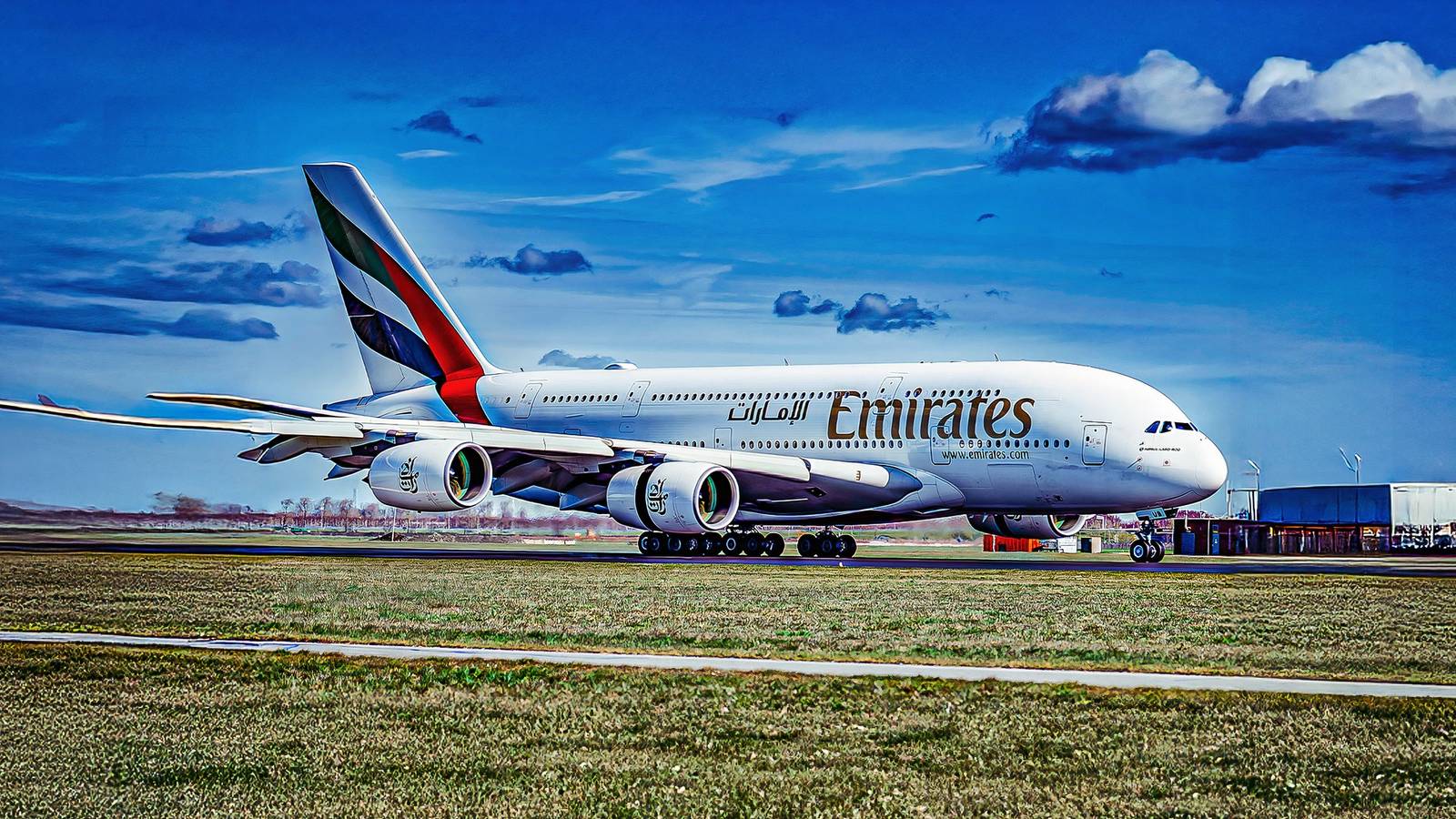
The type's relaunch came two days after another long-haul route welcomed back the A380. Find out more now!
On November 1, Emirates finally reintroduced Airbus A380 service from Dubai International Airport (DXB) to Houston George Bush Intercontinental Airport (IAH). The major Texas airport has superjumbo service again.
The relaunch of double-decker quadjet flights to IAH came two days after the Gulf giant began flying the equipment to Glasgow again. The Scottish city last saw the A380 in early March, so the return was significant.
The United Arab Emirates' largest operator has a reasonably long history of flying to IAH. OAG data shows that the first service took place 19 years ago, in December 2007, when the Boeing 777-200LR — which was designed for such ultra-long missions — was deployed. The larger 777-300ER, which also has significant freight capacity, materialized in March 2012. Then it was the turn of the A380.
The superjumbo first arrived in IAH in December 2014, seven years after the route began. It was deployed daily until early 2020 and returned in December 2022. Flightradar24 shows that the double-decker flew to IAH until February 2026, when the war in Iran meant that the type and the route were temporarily paused.
After a month-and-a-half gap, service from DXB to IAH returned in May 2026, with the 484-seat A380 used. The superjumbo was deployed until August 24, 2026, after which the 276-seat 777-200LR, the original equipment to IAH, was once again flown. With 43% fewer seats for sale, the equipment swap to the Triple Seven would have helped with higher loads, although first class was not available and there were considerably fewer business seats.
On November 1, Emirates reintroduced superjumbo service to IAH. While the great circle suggests 7,098 nautical miles (13,146 km) each way, this is, as always, theoretical. It does not take account of real-world operations. Avoiding Iranian, Ukrainian, and Russian airspace, for example, increased the distance to around 7,211 nautical miles (13,355 km), which is a pretty insignificant increase.
The route continues to run daily on the 484-seat A380 with the following schedule. There are 14 seats in first, 76 in business, 56 in premium economy (40" pitch; 2-4-2), and 338 in economy (32"; 3-3-3). While unsurprising, the number of economy seats (338) is far more than the total capacity of the 777-200LR (276 seats), which operated until October 31.
EK211: 9:40 AM-4:40 PM (17 hours and 00 minutes)
EK212: 7:00 PM-7:45 PM+1 (14 hours and 45 minutes)
Between December 2007 and February 2026, US Department of Transportation data shows that Emirates transported just over 3.5 million round-trip passengers between DXB and IAH. In the 12 months to February this year, 249,000 passengers were carried, with a very low load factor of just 66.0%. Questions must be asked about whether that government figure is accurate. Nonetheless, with first class and so many business seats, the yield performance must make the long and expensive route worth serving.
Booking data suggests that about 70% of the route's traffic connected to another flight in DXB. Predictably, India was by far the most popular country market, followed by Pakistan, Saudi Arabia, the Philippines, Thailand, Kuwait (for oil), Malaysia, Iran, Bangladesh, and Singapore. The top ten cities were Houston to/from Mumbai, Hyderabad, Bengaluru, Karachi, Delhi, Manila, Chennai, Dammam (for oil), Ahmedabad, and Kochi.