
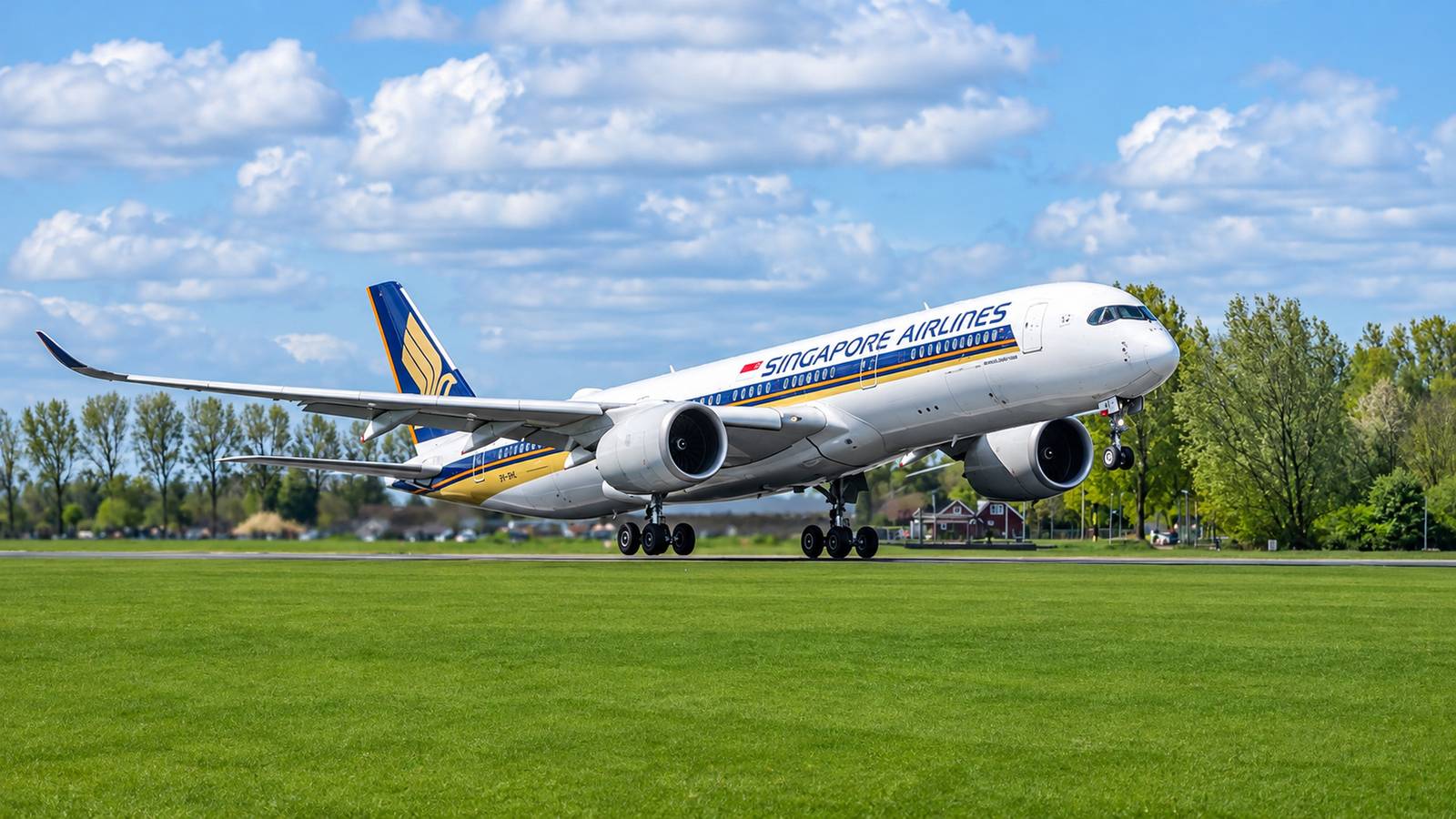
Singapore Airlines is preparing to operate its Airbus A350-900ULRs with just 132 seats, the same sort of capacity that you would typically find aboard an Airbus A220-300.
The redesigned aircraft will feature four first class suites, 70 business class seats and 58 premium economy seats, with no conventional Economy cabin. Although the configuration was first announced in November 2024, Singapore Airlines today unveiled its next-generation cabins, revealing what passengers can expect on the world's longest nonstop flights.
Singapore Airlines has unveiled its next-generation long-haul cabin products, including all-new first class and business class seats, part of a S$2 billion ($1.6 billion) investment in the passenger experience. Developed following research involving more than 5,000 customers, staff and industry experts, the new interiors prioritize privacy, comfort and flexibility. Singapore Airlines' CCO Lee Lik Hsin explained the philosophy behind the redesign:
"Singapore Airlines’ next-generation long-haul cabin products will ensure that our customers travel even more comfortably than before, and have greater control over their in-flight experience."
The new cabin overhaul will cover 34 long-haul Airbus A350-900s (excluding the regional A350 fleet) and the airline's incoming Boeing 777-9 fleet, which is set to arrive from late 2027. Also included is the airline's A350-900ULR sub-fleet, and it is here where the impact of the new cabins will be most visible, transforming the widebody into an even-more-premium aircraft with the total capacity of a small narrowbody.
The airline's seven A350-900ULRs were specifically developed for exceptionally long routes, featuring a range of up to 11,160 miles (17,960 km). Introduced in 2018, they enabled the resumption of nonstop from Singapore Changi Airport (SIN) to New York JFK Airport (JFK) and Newark Liberty International Airport (EWR). Unlike conventional A350-900s, the ULRs have always operated without economy class, currently accommodating 67 business class and 94 premium economy passengers.
The headline addition is four first class suites, introducing the cabin to the ULR fleet for the first time. Designed by PriestmanGoode and manufactured by Collins Aerospace, the suites feature curved sliding doors, companion dining and personalized controls. The two center suites can also transform into a shared sofa, or what Singapore Airlines describes as commercial aviation's largest double bed.
Business class increases from 67 to 70 seats, with new RECARO suites offering sliding privacy doors, fully flat beds, improved ergonomics and companion-bed options. Passengers will also benefit from a redesigned KrisWorld entertainment system, featuring 4K displays, Bluetooth connectivity and personalized settings. New BYREDO amenity kits and business class sleeper suits will further enhance the experience.
Premium Economy will have a significant reduction, losing 36 seats, or 38% of its capacity. Importantly, the ULRs will retain their existing premium economy seat product, rather than receive the entirely new seats that are destined for the 777-9. Nevertheless, refreshed amenities and entertainment will improve the passenger experience.
Passengers will have to wait longer than originally expected for the new cabins. Singapore Airlines initially targeted the second quarter of 2026 for its first standard A350 retrofit, followed by the ULR in early 2027. The initial introduction was postponed in May, and today's announcement places the progressive rollout in the second half of 2027, without specifying when the first retrofitted ULR will enter service.
Standard A350 delayed to Q1 2027; ULR timing unconfirmed
Originally all 41 A350 retrofits by end of 2030; revised completion date unconfirmed
Certification remains a significant obstacle. Singapore Airlines previously cited supply chain constraints and delays in approving a new seat. According to The Business Times, the seats have received certification for the 777-9, but not yet for the A350. The two aircraft require separate approvals, meaning certification on Boeing's aircraft does not automatically authorize installation on Airbus' widebody, which is what is pushing back the first rollout to the second half of next year.
The Boeing connection goes considerably deeper. Singapore Airlines originally developed these premium products for its incoming 777-9s, but repeated delays to Boeing's flagship widebody encouraged the airline to also extend the program to existing A350s. Its 777-9s will feature four cabin classes, and unlike the A350s, will receive the new premium economy and economy products as well.