

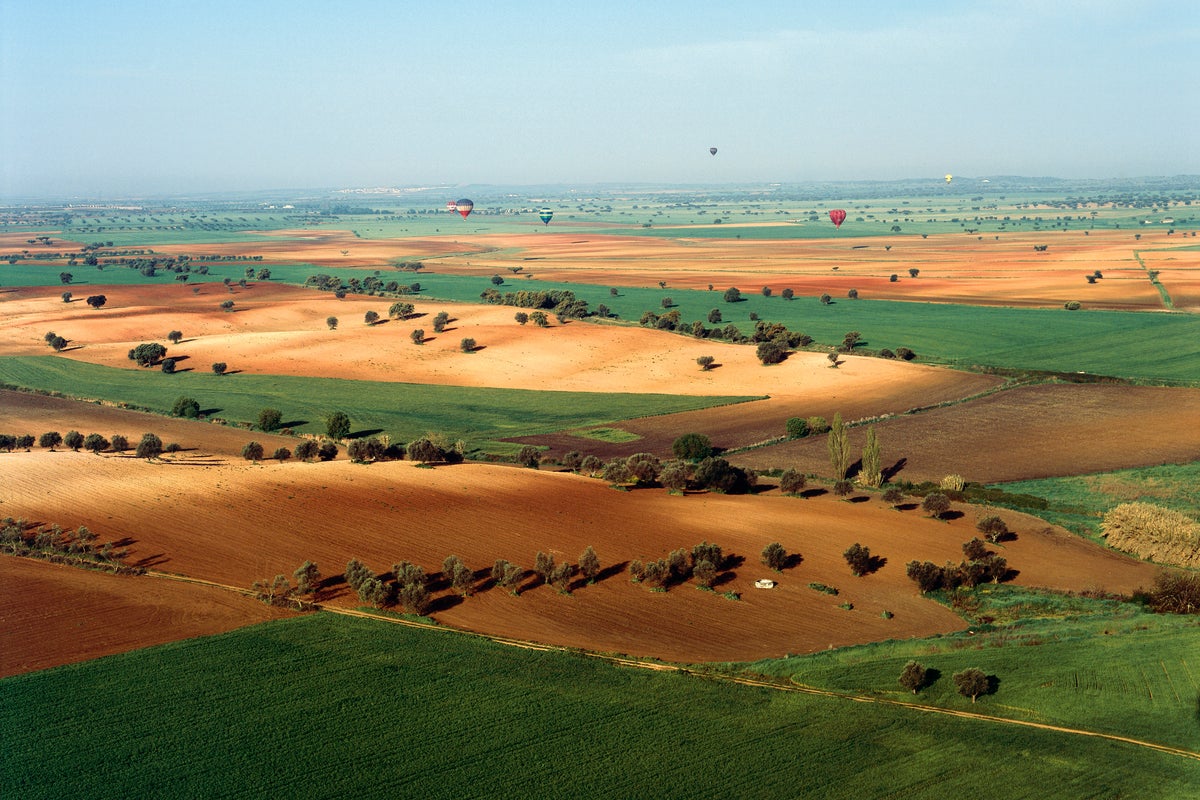
Away from the resorts of the Algarve, Geordie Greig takes a road trip around Alentejo, weaving his way through Roman history, across a landscape where tradition meets ambition
Want to bookmark your favourite articles and stories to read or reference later? Start your Independent Membership today.
It is easy to underestimate Portugal beyond the usual Algarve beaches. Small on the map, pressed against Spain and facing the Atlantic, it was once the centre of a remarkable maritime empire, sending ships around Africa, into India, across Asia and to Brazil. Romans and Moors, Christian kings and military orders, explorers, aristocrats and dictators have all left their mark. For nearly half a century the country was controlled by the Estado Novo dictatorship, until the Carnation Revolution of 25 April 1974 changed everything.
Even Coca-Cola was effectively kept out for decades, associated with American influence; official sales only began in 1977. It sounds faintly absurd now, but it is a useful reminder of how different Portugal once was.
Drive south from Lisbon and another Portugal gradually appears. The traffic thins, the roads narrow and the landscape opens: pines gather above the tarmac, cork oaks stand alone in dry grass, olive groves run towards distant hills and white villages appear and disappear. The Alentejo occupies roughly a third of Portugal’s land but little more than five per cent of its population. At times it feels like Tuscany before Tuscany became famous — immense skies, ancient estates, excellent food and beautiful roads without the crowds.
This is not the Portugal of Algarve resorts or the standard tourist circuit, but a land of cork, olive oil, vineyards, Roman stones, medieval castles and food that remains deeply rooted in place.
Our first stop is unexpectedly industrial. In Viana de Alentejo, Moagem Industrial Lodge occupies a former cereal factory, transformed into a hotel and restaurant without disguising its origins. Concrete, steel, terrazzo and machinery remain; a deep pool resembles an enormous stone bath, while a seven-metre chimney rises above the open-fire kitchen. Outside, camouflage netting shades the tables. The architecture has something of Richard Rogers crossed with Terence Conran, but the atmosphere is far from austere: young staff in black shirts and orange braces move between tables, music plays and the mood is relaxed.
At Oagem Kitchen, chef Pedro Dias cooks over fire, giving familiar Alentejo ingredients a modern turn. Olives come with garlic and oregano, bread arrives with fiercely green local olive oil, and a crisp croquette is sharpened with sherry vinegar. Then comes watermelon gazpacho with raw onion and tomato water — sweet, cold, sharp and startlingly good. It is an apt introduction to the region: ancient ingredients, contemporary thinking and a dead factory given another life.
The landscape may look serene, but its history is anything but simple. The Romans brought roads, agriculture, wine and infrastructure; Muslim rule followed, and Christian kingdoms pushed south during the Reconquista. Castles still crown the hills, Roman stones survive in later buildings and whitewashed towns retain narrow streets and traces of Islamic geometry alongside churches and convents. Even the wine is archaeology. Roman influence on viticulture was profound, while the ancient practice of making wine in enormous clay vessels — talhas — survived here for centuries.
Wine, olive oil, cork, bread, pork and herbs are not simply local products. They are the edible history of the landscape.
Read more: Exploring Portugal’s Alentejo coast, from Comporta to the Costa Vicentina
At Ervideira, near Reguengos de Monsaraz, that history meets modern ambition. Silver fermentation tanks stand like industrial sculpture, oak barrels acknowledge tradition and the scale is substantial without becoming anonymous. This remains a family business, and Duarte Leal da Costa, a fourth-generation winemaker, takes us through six wines with the intensity of a man introducing his children. He sometimes even conducts a blind tasting in dark glasses, removing the visual assumptions that so easily influence us. The point is larger than wine: it is about place, memory, people and pleasure.
The family owns 120 hectares of vines and 36 of olives, but the history behind them is marked by loss. The Revolution of 1974 brought catastrophe; the vineyards were destroyed and Duarte’s grandfather died of a heart attack afterwards. Rebuilding became part of the family inheritance. Today there are thirty grape varieties, including a bestselling white made from red grapes, while 30,000 bottles are ageing underwater, some thirty metres below the surface of a reservoir. Yet Duarte’s most touching ambition is the simplest: he wants to build a house among the vines. Not a palace, not a hotel. A house.
The wine story becomes almost prehistoric at Gerações da Talha, where Teresa Caeiro, just 32, is the first woman in Portugal to take charge of making wine in talhas. Even her young daughter has already had a hand in making her own. Grapes arrive at night in the back of a lorry, are unloaded, crushed and piped directly into enormous clay jars. There is no stainless-steel theatre here, only grape, clay, time and nature.
Ervideira and Teresa’s winery could hardly be more different — one medium-sized and ambitious, the other intimate and elemental — yet both are trying to capture the same thing: an expression of the Alentejo.
Then the road brings us to historic and dramatic Évora, where having a guide is invaluable. After the emptiness of the countryside, the city feels almost extravagant: Roman, medieval, royal and ecclesiastical, filled with temple, church, convent, palace and tiled façades. The Roman Temple dominates the old centre, but the pleasure lies in wandering — a tiled wall here, a stone arch there, a palace around the corner. And everywhere, cork: handbags, hats, jewellery, notebooks. The landscape has become the souvenir.
Even the past remains unusually tangible in a palace that has stayed with the same ducal family for roughly six centuries. Here history is not merely preserved behind glass; it is still lived in and inherited.
The city’s restaurants reveal another kind of continuity. At Tua Madre, the Alentejo looks forward: green chairs, white walls and mustard-yellow windows frame food that is playful without losing its roots. Cantabrian anchovies come with focaccia, grilled pepper and tomato sauce; tagliatelle al pomodoro is enriched with lard from a traditional smoker; dark chocolate mousse arrives with organic olive oil and pork scratching. It sounds improbable. It works. Fialho, down another alleyway, is the counterpoint.
With black waistcoats, white tablecloths and serious silverware, it feels as though someone has left the door open to 1950. Smoked ham, codfish carpaccio, Monte Vinha cheese, steak and cod arrive with the solemnity of tradition. Tua Madre looks forward; Fialho looks back. Both belong to Évora.
Beyond the city, the landscape changes again as Alqueva appears: an enormous sheet of blue laid across the dry Alentejo. Europe’s largest artificial lake, shared by Portugal and Spain, has a vast circumference of roughly 700 kilometres. From an American pontoon boat the region becomes even more spacious. Hills roll away without interruption; roads and villages retreat into the distance; the heat rises from the water. A picnic on board feels almost ridiculously simple, while the man-made beach offers a more conventional pleasure. But the real luxury is the emptiness.
Read more: Portugal’s Fisherman’s Trail is the perfect multi-day hike
That same sense of space takes a more polished form at Quinta do Paral, the Wine Hotel surrounded by its own vineyards. Here the Alentejo has been refined rather than reinvented: a tunnel of grapes leads towards the rooms, waterways cross the courtyard, bougainvillea blazes against white and blue buildings, and red-tiled floors, stone benches and fountains create a kind of Mediterranean theatre. There is a pool beneath enormous umbrellas and towels embroidered with a gold P; beyond it, vineyards surround everything like a mosaic.
The food is light and assured — sea bream, samphire, an octopus amuse-bouche — accompanied by the estate’s own wine. This is not rustic Alentejo. It is the contemporary, luxurious version, with the vineyard still at its centre.
The region continues to surprise when the road turns towards design. At the Reguengos Blanket factory, an entrepreneur has kept the old handloom tradition alive by treating it as an art rather than a souvenir. Carpets, rugs, curtains and lampshades are made with the same underlying craft but with an international eye; the factory is simultaneously showroom and studio, and the customers are as likely to be global as local. It is another characteristic Alentejo contradiction: an ancient technique with contemporary ambition.
A little further on, São Lourenço do Barrocal, just outside Monsaraz, offers a more elemental version of luxury. Some of its olive trees are said to be 2,000 years old, and the landscape has an almost African scale and light. The estate combines elegant design with a deep connection to its setting, and an olive-oil tasting, naturally accompanied by its own wine, becomes another way of understanding the region. Above it all sits Monsaraz, its whitewashed houses and medieval walls gathered around the hilltop castle.
The Alqueva reservoir spreads below it, and at sunset the whole place seems to suspend itself between earth and sky. It is one of those rare places where the word atmospheric does not feel like an exaggeration.
Eventually the road climbs for more than two hours towards Marvão, and the scale becomes almost improbable. The medieval fortress town sits high in the São Mamede hills, its tenth-century walls following the mountain and its cobbled streets climbing between whitewashed houses towards the castle. At Hotel do Museu, luxury is stripped back to its essentials. The view stretches across olive groves, Portuguese pines, fields and distant blue hills, with almo