
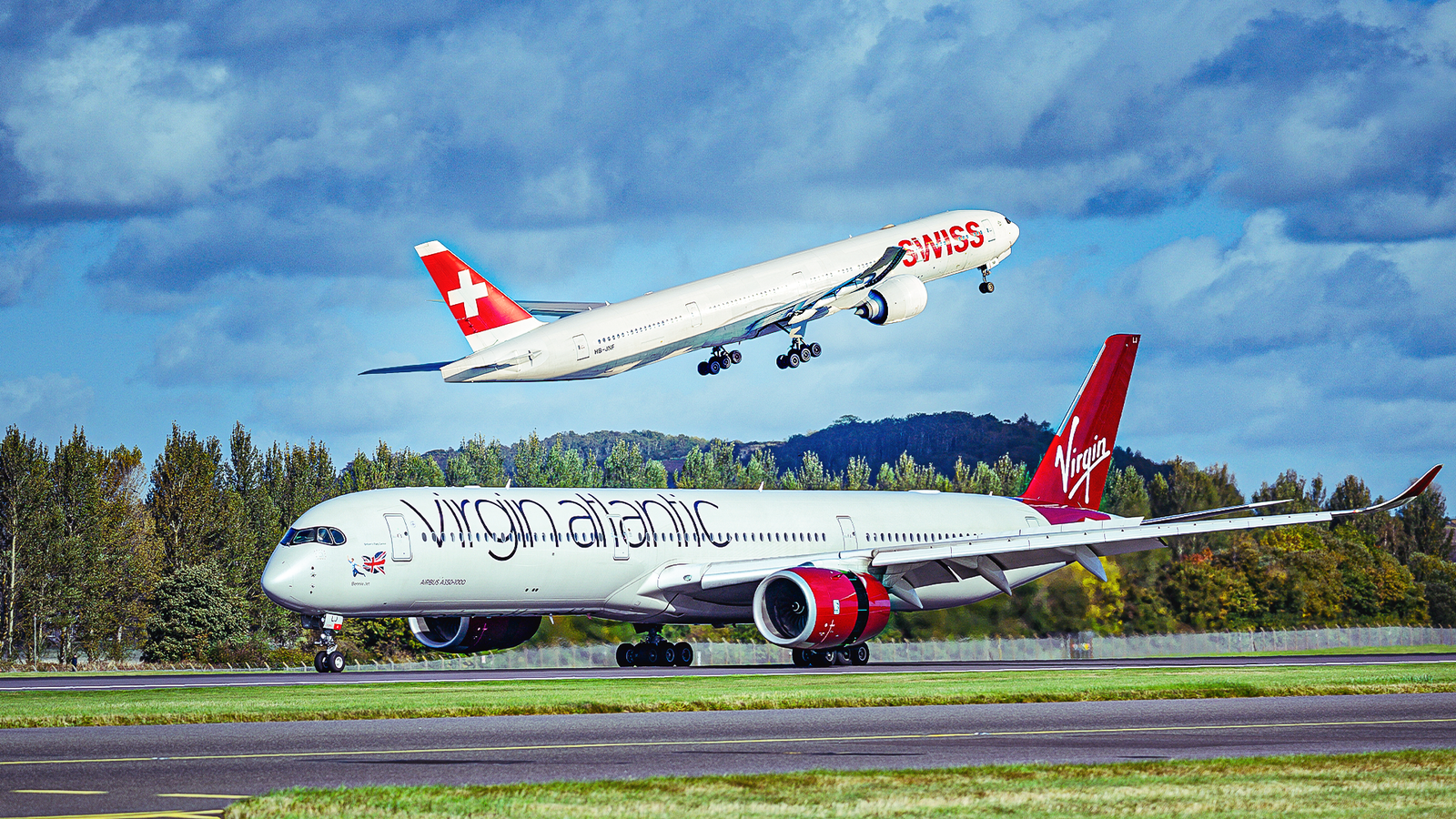
Over many hours of flying, a lower cabin altitude can help passengers feel more rested upon arrival.
Passengers stepping off a 12-hour flight may feel noticeably better after traveling on an Airbus A350 than after making a similar journey aboard an older Boeing 777. The difference is not simply a matter of seat comfort or airline service. The A350 was designed around a newer cabin environment, incorporating lower pressurization altitude, improved humidity retention, and noise-control measures intended to reduce the physical strain of spending many hours in the air.
These features have a credible scientific basis for mattering, though the evidence requires qualification. No major controlled study has directly compared passenger fatigue after equivalent A350 and 777 flights. Aircraft configuration, airline operating practices, seating density, sleep opportunity, and individual health all influence how travelers feel. Nevertheless, the A350 offers several potential advantages over many earlier 777s, particularly on very long sectors. Those benefits can make the journey less taxing, even though they cannot eliminate jet lag.
One of the A350's most consequential comfort features is its ability to maintain a lower cabin altitude. Although the aircraft may cruise above 35,000 feet, its pressurization system keeps the cabin environment at a much lower equivalent altitude. Airbus specifies a cabin altitude of 6,000 feet (1,828 meters) for the A350, a level made possible in part by its carbon-fiber-reinforced plastic fuselage. Older Boeing 777 variants generally operate within the conventional commercial-aircraft limit of 8,000 feet (2,438 meters) at maximum operating altitude.
This is a regulatory ceiling, not a guarantee that every 777 flight remains at precisely 8,000 feet. Actual cabin altitude changes during a flight and varies with operating conditions. Even so, the potential difference between a 6,000-foot A350 cabin and an 8,000-foot cabin is physiologically meaningful.
A 2007 study published in the New England Journal of Medicine examined 502 volunteers during simulated flights in a controlled hypobaric chamber. Researchers exposed participants to cabin pressures equivalent to altitudes ranging from 650 feet to 8,000 feet. At the highest simulated altitude, average oxygen saturation fell by as much as 4.4 percentage points compared with the lowest condition. Participants also reported more discomfort, including fatigue and muscular discomfort, at 7,000 to 8,000 feet. Those differences emerged after three to nine hours of exposure.
The researchers did not find that the lower oxygen levels caused acute mountain sickness or measurable impairment in sensory and psychomotor testing. Their conclusion was more specific: maintaining a cabin altitude of 6,000 feet or lower could reduce passenger discomfort on long flights. This supports the A350's approach, but it does not prove that every traveler will arrive less tired or that the aircraft prevents fatigue. Pressurization performance varies by generation and operating conditions.
Nevertheless, the A350's lower target gives it a tangible advantage in an area where scientific research has established a relationship between cabin altitude and passenger discomfort.
Cabin humidity is another factor that can influence how comfortable passengers feel after a long flight. The air supplied to aircraft cabins at cruising altitude is extremely dry. Relative humidity on many long-haul flights commonly falls between 10% and 20%, well below levels people experience indoors on the ground. Low humidity does not normally cause clinically significant dehydration in healthy passengers. It can, however, dry the eyes, nose, throat, and skin, making a long journey feel less comfortable. Increasing cabin humidity improved nasal comfort while reducing ocular, nasal, and skin symptoms.
The A350's composite fuselage helps address an engineering constraint behind cabin humidity. Traditional aluminum structures are more vulnerable to corrosion when exposed to sustained moisture, so aircraft manufacturers have historically limited humidity to reduce the risk of condensation and structural deterioration. Composite materials are less susceptible to that form of corrosion, giving designers greater flexibility to manage moisture levels.
Airbus says the A350 combines its carbon-fiber structure with improved humidity levels during cruise, contributing to lower passenger fatigue. Independent aviation-health research also notes that newer composite aircraft, including the A350 and Boeing 787, can retain more moisture than older designs. Cruise humidity around 15% has been reported in some cases. This does not mean every A350 cabin remains at 15% to 20% throughout a flight. Humidity varies with passenger numbers, ventilation rates, and operating conditions, and it is not routinely monitored in commercial cabins.
Passengers may notice fewer dry-eye symptoms or less irritation after many hours, particularly when improved moisture retention accompanies lower cabin altitude. Humidity alone is unlikely to determine whether someone arrives exhausted, but it can remove one source of discomfort that becomes more noticeable as flight time increases.
Noise is less straightforward to compare because measurements depend on where they are taken, which engines power the aircraft, the phase of flight, and the seating area. Airbus describes the A350 as the quietest aircraft in its category and says its noise-optimized airframe and engine nacelles can make it up to nine decibels quieter than competing aircraft. The Rolls-Royce Trent XWB engines, aerodynamic design, and cabin insulation contribute to its acoustic environment.
Independent measurements offer a more restrained picture. Researchers found that the differences between the several widebody aircraft measured were relatively small, within approximately three decibels. The A350 was not the quietest aircraft in that particular sample, with the Airbus A380 recording the lowest levels. These findings show why manufacturer comparisons should not be interpreted as a universal passenger experience. Even small reductions in background noise can help on a long flight.
A steadier acoustic environment may make it easier to read, relax, or sleep, especially for passengers sensitive to engine noise or cabin activity. Noise also interacts with other conditions: someone in a quiet business-class suite may rest better than a traveler seated near a galley, regardless of aircraft type.
The A350's cabin environment does not make it superior in every aspect of passenger comfort. The 777 has a slightly wider fuselage. That extra space can matter, especially in economy class, where airlines decide how to divide the cabin among seats, aisles, and sidewalls. Seat width depends heavily on the carrier's layout, as the 777 can be configured with nine seats across in economy or with ten seats across. The same principle applies to the A350, where a common ten-abreast economy arrangement can reduce individual seat width.
Overall, aircraft dimensions therefore do not tell passengers exactly how much personal space they will receive.
Singapore Airlines provides a useful illustration of how the comparison changes by cabin. Its 777-300ER economy layout can offer wider seats than its A350-900, making the larger Boeing a potentially better choice for travelers who prioritize shoulder room. Yet the A350 may be preferable for passengers who value a lower cabin altitude, a more modern acoustic environment, and potentially less dryness on long sectors. The airline's actual seat map and aircraft assignment matter more than a simple manufacturer-versus-manufacturer ranking.
Premium cabins introduce further variables. Seat design, privacy, bedding, service standards, and the ability to lie flat can have a greater effect on rest than small differences in cabin pressure or noise. A well-designed 777 business-class seat may be more comfortable than a poorly configured A350 cabin, while a spacious A350 suite can make the journey feel substantially easier. Passengers should compare the specific airline product rather than assuming that the aircraft model alone determines comfort.
The aircraft provides the physical environment, but airlines determine many of the conditions passengers experience within it. Cabin temperature, lighting schedules, meal timing, service interruptions, seating density, and crew procedures can all influence rest. An A350 operated with bright cabin lighting during intended sleep hours or frequent service interruptions may offer less restorative rest than a carefully managed 777 flight. Passenger circumstances, including sleep before travel, departure time, stress, and seat location, also shape how travelers feel on arrival.
Someone seated beside a busy galley may experience more disruption than a passenger in a quieter window seat.
For travelers choosing between comparable flights, the A350 may provide a more favorable environment for a long journey. However, aircraft substitutions and differences in airline configurations make it worth checking the scheduled aircraft and seat map before departure. It is also necessary to distinguish general travel fatigue from jet lag, which occurs when the body's internal clock falls out of alignment with local time after crossing time zones.
The A350's advantage over older 777s may also become less pronounced as Boeing introduces the 777X. The forthcoming aircraft family is being designed with a quieter cabin, improved humidity, cleaner air, and other passenger-focused upgrades. However, Boeing's often-cited 6,000-foot cabin altitude figure currently applies to its BBJ 777X business-jet offering at maximum cruise altitude. It should not automatically be treated as the confirmed specification for every future commercial 777X configuration.
Ultimately, passengers may arrive feeling less tired after flying on an A350 than on an older 777, particularly when flights are similar in duration, schedule, and cabin class. The strongest ev