
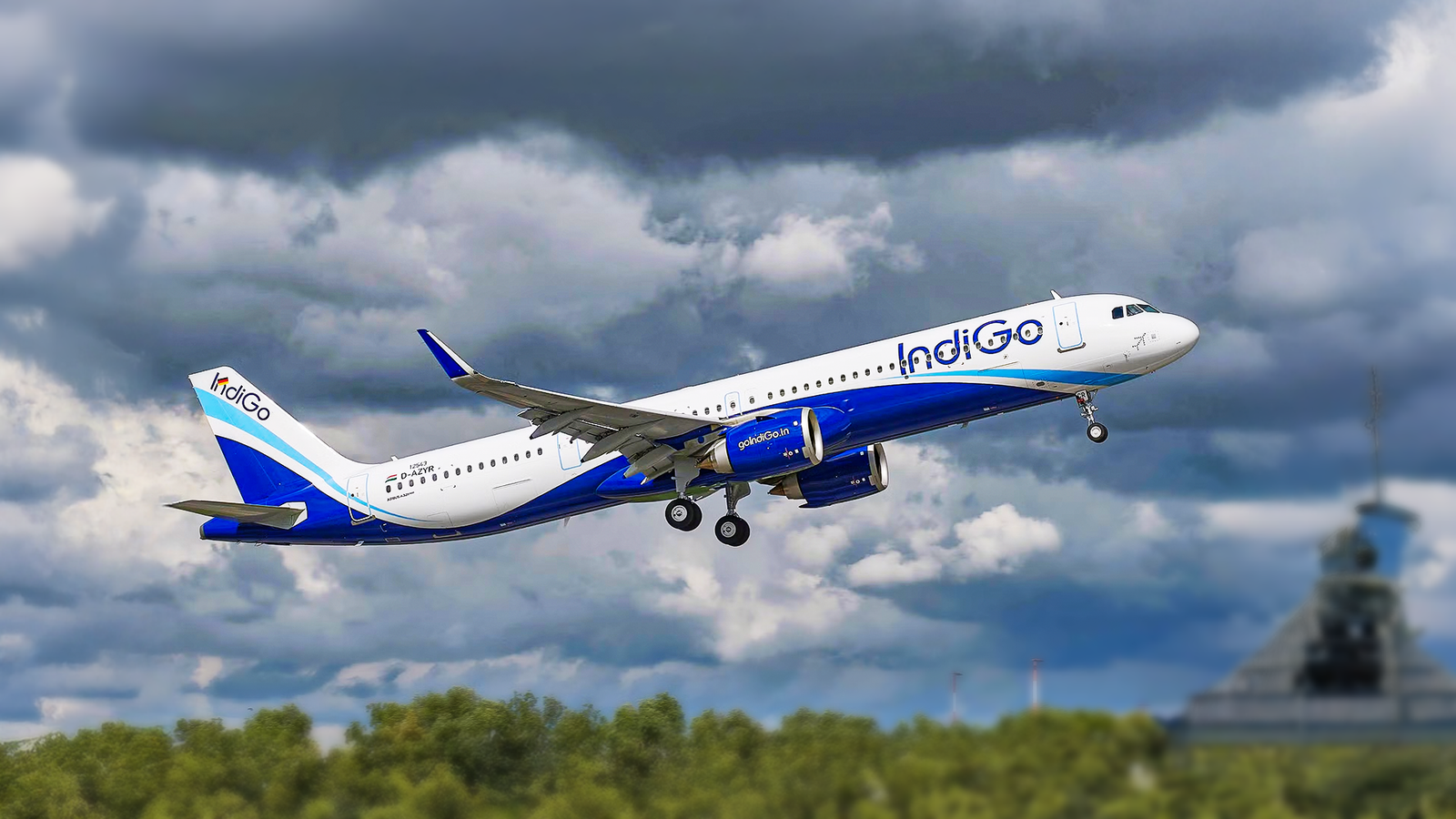
This is the detour the world's longest Airbus A321XLR flight takes every day.
On October 25, IndiGo started operating its flights between Mumbai Airport (BOM) and Amsterdam Schiphol Airport(AMS) with the Airbus A321XLR, replacing the leased Boeing 787-9 Dreamliners previously used on the route. At approximately 3,707 nautical miles (6,865 km), this is now the world's longest scheduled route operated by the A321XLR, with a scheduled flight time of around 10 hours from India to the Netherlands.
However, the actual distance flown is considerably longer due to airspace restrictions across the Middle East and South Asia. Using the Simple Flying Flight Tracker, we examined the routing of flight 22 from Amsterdam to Mumbai on November 1, as well as the flight times recorded during the aircraft's first 11 days on the route. Interestingly, the data shows that although the A321XLR is smaller and generally slower than the Boeing 787-9 Dreamliner, its average flight time to Amsterdam has been shorter.
On November 1, IndiGo flight 22 departed Amsterdam at 2:31 PM local time, operated by an A321XLR registered VT-NLC. According to our flight tracking data, the aircraft spent approximately nine hours and nine minutes in the air before landing in Mumbai at 4:10 AM local time the following morning. Rather than following the shortest possible route toward India, the aircraft followed a more southern trajectory through Europe and the Middle East.
After departing Amsterdam, the aircraft headed southeast across Central Europe before continuing toward Turkey and Iraq. From there, the route passed through the Gulf region and Oman, avoiding Iranian airspace, before continuing toward India's western coast and eventually Mumbai. The tracking data shows how the aircraft avoids both Pakistan and Iran, despite these countries lying along the more direct route between Mumbai and Amsterdam.
The distance between Mumbai and Amsterdam is about 3,707 nautical miles (6,865 km) along the shortest route. However, according to Aerospace Global News, the necessary detours can increase the actual distance flown to approximately 4,200 nautical miles (7,778 km), or around 13% longer. This puts the flight much closer to the A321XLR's advertised maximum range of 4,700 nautical miles (8,704 km).
One of the main reasons for IndiGo's detour is the ongoing closure of Pakistani airspace to Indian airlines, in place since April 2025 following rising tensions between the two countries. According to the International Civil Aviation Organization (ICAO), the restrictions apply to aircraft registered in India, as well as those owned, operated, or leased by Indian carriers. Pakistan has since extended the restrictions several times.
At the same time, the ongoing conflict in the Middle East has also made flying through Iran increasingly difficult. Although Iranian airspace is not subject to the same ban for Indian airlines, the European Union Aviation Safety Agency (EASA) currently advises operators to avoid Iranian airspace at all altitudes.
For IndiGo, Pakistan's restrictions and the security situation in the Middle East considerably reduce available routing options between India and Europe. The airline must therefore follow a longer route, which increases fuel requirements and operating costs. The implications are particularly significant for the A321XLR, as the aircraft has far less flexibility to carry additional fuel and passengers on such a long flight than a widebody such as the Boeing 787-9 previously used on the route.
Although Airbus advertises the A321XLR with a range of up to 4,700 nautical miles (8,704 km), the actual range depends on several operational factors, including passenger weight, cargo, fuel reserves, and weather conditions. The additional distance flown between Mumbai and Amsterdam consequently puts the aircraft much closer to its operational limits. To ensure that the flight can be completed nonstop, IndiGo reportedly restricts the number of seats it makes available for sale.
According to avicionline, IndiGo is currently selling fewer than 140 seats on the Mumbai-Amsterdam leg, despite its A321XLRs having a total capacity of 195 passengers. The aircraft are configured with 12 IndiGoStretch business class seats and another 183 economy class seats, meaning that over 25% of capacity is reportedly unavailable for sale. However, this restriction is not necessarily identical in both directions, as the aircraft's fuel requirements may differ depending on weather and other operating conditions.
Compared with the 787-9 previously operated on the route, this represents a considerable reduction in available capacity. The Norse Atlantic Airways aircraft offered 338 seats, including 56 premium and 282 economy class seats, according to IndiGo's original route announcement. While the A321XLR already has 143 fewer installed seats, additional restrictions on the Mumbai-Amsterdam leg mean almost 200 fewer seats may be available than on the previous widebody operation.
Interestingly, analysis of Flight Tracker data indicates that in the first 11 days of A321XLR operations, the aircraft spent less time in the air on flights from Mumbai to Amsterdam than the Boeing 787-9. Between October 25 and November 4, flight 6E21 recorded an average airborne time of nine hours and 36 minutes, approximately 20 minutes shorter than the average of nine hours and 56 minutes recorded by the 787-9 during its final nine flights.
However, the opposite was true in the other direction: the A321XLR averaged nine hours to fly from Amsterdam to Mumbai, compared with eight hours and 31 minutes for the 787-9.
Looking at the individual flights, the fastest A321XLR service from Mumbai to Amsterdam was recorded on October 28, when VT-NLD completed the journey in nine hours and 19 minutes. The longest was the first flight on October 25, when the same aircraft spent nine hours and 52 minutes in the air. For comparison, the longest 787-9 flight during the period examined took 10 hours and 15 minutes on October 20.
On the return journey, the fastest A321XLR service took eight hours and 32 minutes, while the longest required nine hours and 14 minutes, compared with a range of eight hours and 19 minutes to eight hours and 43 minutes for the 787-9.
However, this does not necessarily mean the A321XLR is operating more efficiently or at higher speeds than the 787-9. The two aircraft were operating at different times of day, with the 787-9 previously scheduled to depart Mumbai at 12:25 PM and Amsterdam at 8:35 PM local time, compared with 6:25 AM and 2:15 PM for the A321XLR. The comparison also covers two different periods around the start of the winter schedule, meaning wind conditions, air traffic restrictions, and the actual routings flown may have differed.
The 787-9 also generally cruises faster than the A321XLR, making it difficult to attribute differences in airborne time to the aircraft types themselves.
According to flight tracking data, IndiGo has already used four different Airbus A321XLRs on its Mumbai–Amsterdam service since October 25. In addition to VT-NLD, this includes VT-NLA, VT-NLB, and VT-NLC, with all four operating at least two flights from Mumbai to Amsterdam during the first 11 days of operations. VT-NLC has been the most frequently used aircraft, completing four services in each direction, while VT-NLD operated three flights to Amsterdam and VT-NLA and VT-NLB operated two each.
Although four aircraft appear in the flight-tracking data, the schedule allows IndiGo to operate both directions with the same aircraft within about 24 hours. On November 1, for example, VT-NLC landed in Amsterdam shortly before noon local time, before departing again at 2:31 PM. This left approximately two hours and 33 minutes between landing and takeoff, after which the aircraft arrived back in Mumbai at 4:10 AM local time the following morning.
The relatively short turnaround times allow IndiGo to operate the daily service without dedicating several aircraft exclusively to the route. Meanwhile, the airline has continued rotating its A321XLRs across other international services, including flights to Athens and Istanbul Airport (IST), where the aircraft type is also being deployed. The Mumbai-Amsterdam route nevertheless represents a considerably longer operation than those services, making it particularly dependent on the aircraft's available range and the routing restrictions currently affecting flights between India and Europe.