
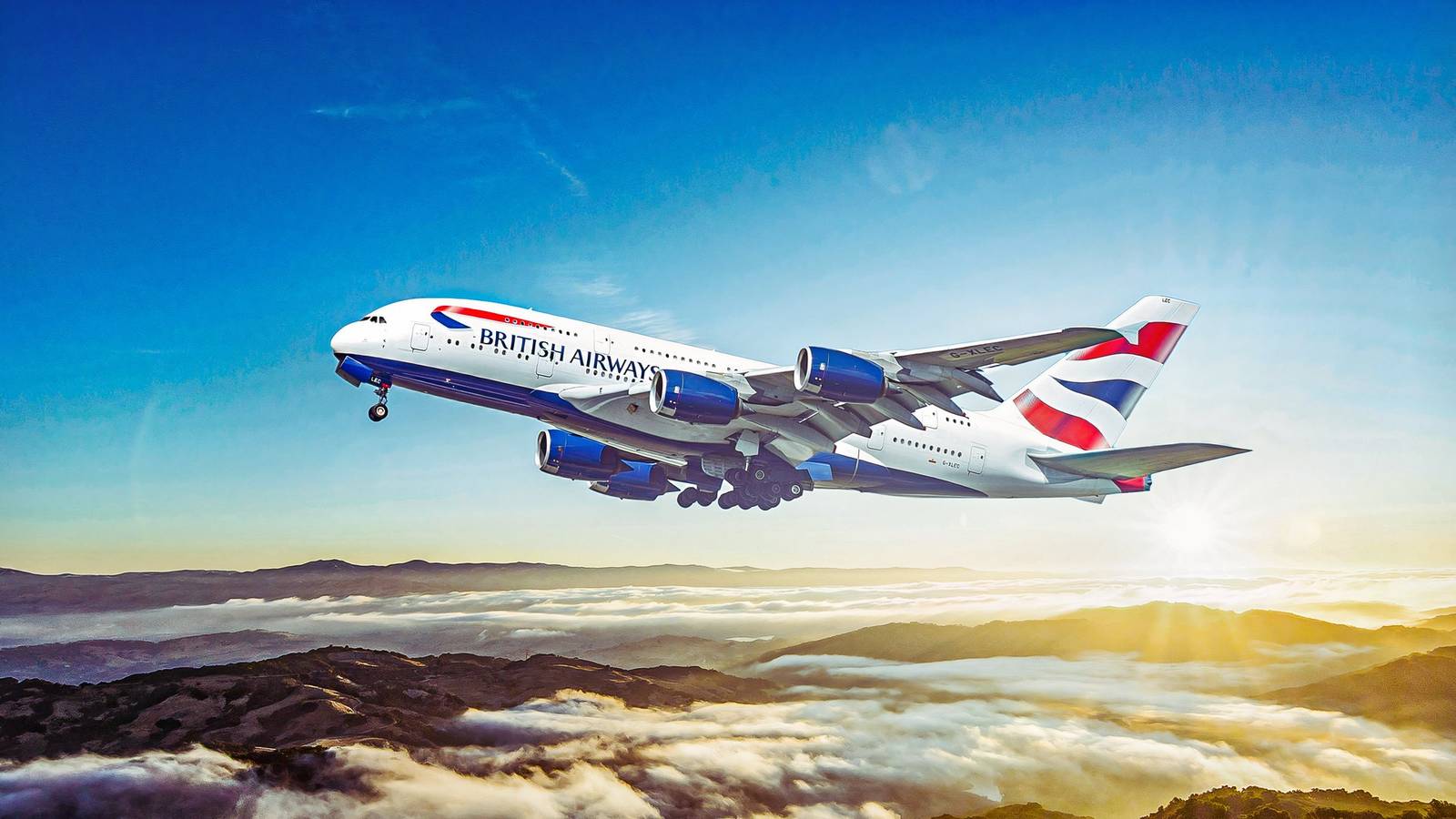
British Airways is one of ten scheduled users of the Airbus A380. The airline has cut eight major A380 routes from Heathrow.
British Airways is one of ten scheduled users of the Airbus A380. Mainly due to airframes being taken out of service to be retrofitted with just 421 seats, Cirium Diio shows that the carrier now only has the sixth-highest number of double-decker flights. Last November, it was second.
Ch-aviation shows that the oneworld member has 12 double-decker quadjets, the last of which was delivered in June 2016. While they currently have 469 seats, they're being retrofitted with new seats, with a higher premium offering. 88 economy seats are being removed, enabling 13 more business suites and 29 more premium economy seats. The equipment is, of course, used in high-volume and high-yielding markets.
The UK flag carrier's first commercial flight on the superjumbo took place in August 2013. The equipment was initially deployed to Frankfurt for crew training and familiarization. Many airlines have deployed their superjumbos on very short routes for this purpose. For example, Air France did so to London Heathrow Airport (LHR), while Singapore Airlines flew it to Kuala Lumpur. BA used the A380 to Frankfurt and Madrid in 2021 for the same reason, which was ahead of the type's reentry into service due to the COVID-19 pandemic.
Comparing BA's schedule between August 2013 and October 2026 with what's planned from November 2026 through 2027 shows that the following eight routes no longer see the huge equipment. Singapore would also have featured, but BA reintroduced superjumbo service to Lion City two months ago: more on that later.
Notice Dubai. Ordinarily, BA would fly the 469-seater to the United Arab Emirates' massively popular destination during the winter, when the temperature is hot but not extraordinarily so. This is, therefore, the main tourist season. However, due to the ongoing war in Iran, the equipment is no longer deployed there. While no flights are currently scheduled through next October, the type may return next winter. BA only just returned to Dubai at the start of November 2026, with the Boeing 787-10 operating daily.
On September 6, BA11 left the UK's busiest airport for Singapore Changi Airport (SIN), having last been deployed to Lion City in early 2025. It is unclear if the return to SIN was influenced by the unease of passengers in connecting at Gulf hubs, although this seems to be dissipating. Whether coincidentally or not, other A380 operators have removed the type from SIN recently. Qatar Airways did so in March 2026, followed by Etihad three months later.
The return of BA's A380s to SIN is notable in various ways. First, it became the airline's sole remaining superjumbo destination in Asia, with only Hong Kong, Doha, and Dubai previously served. Second, LHR-SIN has three double-decker operators for the first time in 16 months, with BA joining Qantas and Singapore Airlines. It is now the only airport pair with three A380 operators.
Third, and just as significantly, if Emirates (the granddaddy of A380 operators) is excluded, LHR-SIN now has more superjumbo flights than any other airport pair, with four flights each day. SIN-Sydney comes close, but has three daily flights at times.
Like other Northern Hemisphere airlines, BA switched to winter schedules on Sunday, October 25, 2026, based on IATA slot seasons. It'll maintain winter operations through Saturday, March 27, 2027. In this period, and primarily reflecting aircraft undergoing reconfiguration, BA will only fly the double-decker on four routes from LHR: to Johannesburg (two daily), Miami (daily), San Francisco (daily), and SIN (daily).
Compared to last winter, superjumbo services have been reduced by 27%, which is why BA has temporarily fallen from being the second-largest operator by flights to sixth. At the time, six routes existed: LHR to Dubai (daily), Johannesburg (daily), Los Angeles (daily), Miami (two daily), San Francisco (daily), and Washington Dulles (daily through early November 2025). The equipment will return to Los Angeles in 2027, but it is unclear if Dubai will see it again.