

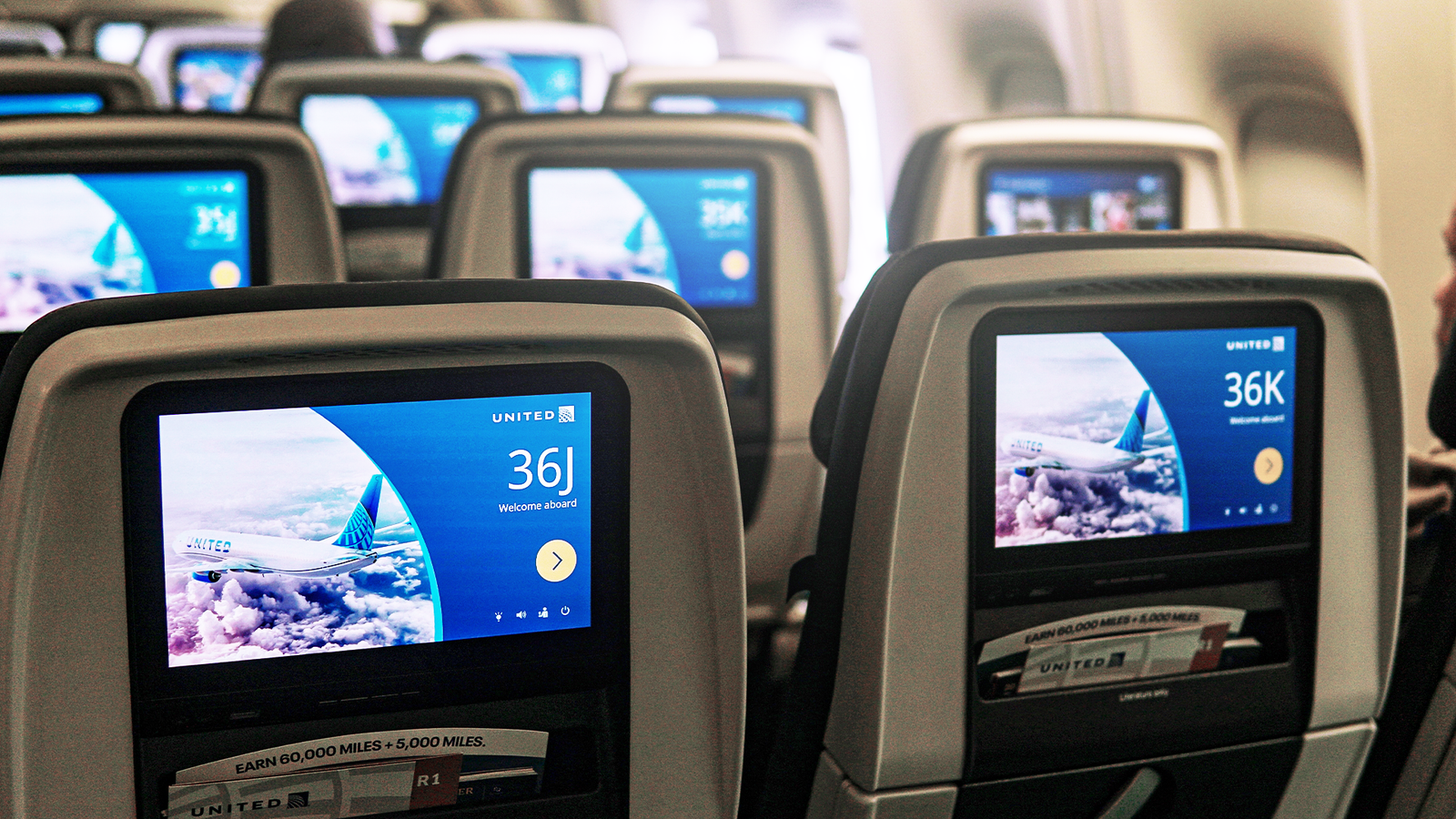
United Airlines operates some of the most unusual economy seats in the industry, offering more pitch than standard economy seats.
United Airlines operates some of the most unusual economy seats in the industry, and passengers lucky enough to find them can enjoy an experience that rivals premium economy. Hidden toward the back of the carrier's Boeing 767 aircraft are four seats offering an impressive 43 inches of pitch, extendable leg rests, footrests, and additional recline. With an entire foot more pitch than United's standard economy seats, these unusual accommodations are the most spacious options available in the airline's economy cabin.
However, these seats don’t exist for passenger comfort; rather, they serve as dedicated inflight crew-rest accommodations, giving flight attendants somewhere to relax during longer international journeys. United occasionally makes them available for passenger reservations when the aircraft operates shorter routes that do not require dedicated crew-rest facilities, creating an unusual opportunity for travelers to secure some of the most spacious seats in the cabin.
Tucked into the back of the economy cabin on all of United’s 16 Boeing 767-400ER aircraft are two pairs of four seats unlike any other on the aircraft. Located in rows 52 and 53 in the A and B positions on the left side of the cabin, these four seats offer a whopping 43 inches of seat pitch. That means these seats offer an entire foot of additional pitch compared to the 31 inches that come standard in United’s economy cabin.
Pitch, also known as the distance between a point on one seat and the same point on the seat in front, is the most impressive number here because these seats take up a much larger footprint. On the left side of the aircraft, in the same space where United has just two rows on the right side, the airline fits three rows of standard economy seats, reflecting just how special the set of four seats truly are.
Compared with economy plus, United’s extra-legroom offering, the seats boast nine additional inches of legroom and even offer five additional inches of pitch compared with premium economy toward the front of the aircraft.
The additional improvements don’t stop at seat pitch, however. They also include additional cushioning, greater recline (approximately seven inches), and extendable leg rests and footrests, bringing these seats closer to what one can expect in premium economy rather than standard economy. Additionally, these seats have curtains that can be drawn around the seating area. When available to passengers, seats 52A, 52B, 53A and 53B are easily among the best in the economy cabin.
With an incredible amount of legroom and the additional amenities in rows 52 and 53, it raises the question of why United chose to install these special seating pairs. The reasoning behind this has nothing to do with the passengers at all. Rather, the unusual configuration exists because flight attendants need somewhere to rest sufficiently during long international flights, like Newark Liberty International Airport (EWR) to Sao Paulo Viracopos International Airport (GRU) or Washington Dulles International Airport (IAD) to Barcelona-El Prat Airport (BCN), the 767-400ER frequently operates.
The design of the seats hints at the true purpose they serve. Rather than installing a dedicated bunk compartment like those found on many larger long-haul aircraft, United instead uses these specially modified seats to increase overhead bin and galley space. United’s agreements with its flight attendants formally require two rows of two seats, providing enough room for two flight attendants to rest during scheduled crew breaks.
The leg and footrests also play an important role in ensuring flight attendants can take a refreshing rest break. The additional recline makes the seats much more suitable for sleeping than an ordinary economy seat, while the curtains provide an enhanced sense of privacy from passengers and cabin activity. When the rest area is not in use, the curtains can be left open, making the seats appear like an unusual addition to the economy cabin for casual travelers.
The availability of the four seats ultimately depends on whether United needs them for its flight attendants. On long-haul international services, typically those longer than eight hours, flight attendants must take rest breaks inflight. In those scenarios, United blocks off its additional economy seats to serve as the crew rest area when inflight. This means passengers cannot select them even if they are willing to pay for additional legroom. The curtains and specialized features that come with the seat are there to support the crew first, not create another passenger seating category.
However, when United’s 767-400ERs operate shorter domestic services, often transcontinental flights between major hubs, the flight usually is not long enough to require a mandated crew rest period, meaning United can release the seats for passenger use. This situation is when lucky passengers may find them listed as Economy Plus on the airline’s booking platform. The Points Guy has previously reported that United generally blocks these positions well in advance and may release them about 24 to 48 hours before departure when not required for crew rest.
While most travelers booked in United economy would have to upgrade to Economy Plus in order to be able to select these seats, United elite status holders have an advantage when seats are released. United’s lowest elite status holders, those with Silver Premier status, can select Economy Plus seats for free at check-in. All other United elites, including Gold, Platinum, 1K and Global Services, can move to Economy Plus for free at booking, although most will have to wait to select the crew rest seats until they become available a few days before departure.
Passengers hoping to find the unusual seats will first need to identify the correct aircraft and seating configuration. Luckily for travelers, all of United’s Boeing 767 aircraft are equipped with four special seats at the rear of the economy cabin, even the carrier’s Boeing 767-300ER airframes. The retrofitted 767-400ER, now the only configuration of the type in United’s fleet, features a three-cabin configuration with 231 seats in total, including 34 United Polaris business-class seats, 24 Premium Plus seats and 173 Economy and Economy Plus seats.
When looking at United’s online booking or check-in platform, there are several recognizable characteristics that can help confirm the aircraft type. Aside from a designator present at the top of the seat map specifying what type of aircraft is operating the route, the most noticeable way to tell a 767 apart from United’s other widebody aircraft is the 2-3-2 seating configuration in economy. On the 767-400ER, the four crew-reset positions are located in the final two rows, making seats 52A, 52B, 53A and 53B the ones to look out for on these aircraft.
United’s 767-300s, which also feature the specialized crew rest seats, have a similar overall layout to the 767-400ER, albeit with less length. Given this, the unique seats can instead be found in rows 43 and 44, with 43A, 43B, 44A and 44B all containing the leg rests, footrests and additional recline. Online seat map databases, like aeroLOPA and Simple Flying’s own seat map database, can provide further insight into the position of each seat.
While United’s Boeing 767 aircraft are the carrier’s only widebody aircraft without a dedicated cabin crew rest area, United also operates countless long-haul or transoceanic routes onboard smaller narrowbody aircraft, including the Boeing 757, Boeing 737 and soon, the Airbus A321XLR. On these single-aisle aircraft, airlines generally have much less space to install dedicated crew-rest compartments, so blocked-off passenger seats can serve a similar purpose.
On the Boeing 757, United frequently blocks off at least one Polaris business class seat for one of the three pilots operating long-haul flights to take a break inflight. For flight attendants on these routes, a curtained-off row of economy seats towards the rear of the aircraft is standard. A similar strategy is used for Boeing 737 flights long enough to require crew rest breaks. On routes like United’s famous island hopper, the airline blocks off two first class recliners to provide space for the crew to rest, as well as a row of economy seats in most scenarios.
Looking ahead, the Airbus A321XLR further demonstrates how airlines are being forced to adapt to these arrangements as narrowbody aircraft increasingly operate longer international routes. American Airlines, for example, has detailed plans to block off two rows of seats, 33 ABC and 34 DEF, to serve as a couch of sorts, with a sleeper pad and curtains for its flight attendants on long flights. Several other innovative solutions, like Diehl Aviation’s crew rest compartment, can be installed to provide a module with two beds dedicated to crew breaks.
Ultimately, crew-rest arrangements depend on the aircraft and length of operations, with United’s four enhanced 767 seats providing a relatively simple solution to a potentially complex and expensive problem.
Providing adequate rest facilities is a crucial part of long-haul flight planning, especially those that operate overnight or cross multiple time zones. Flight attendants have numerous safety responsibilities throughout the journey, including monitoring the cabin, assisting passengers who need assistance, and responding to inflight emergencies. Having an appropriate place to rest during designated breaks is therefore an important part of managing extended operations.
Crew-rest requirements also influence how airlines schedule their flights and configure their aircraft. For aircraft like United’s 767s or other narrowbodies, without crew rest compartments built into either the overhead or cargo hold, longer flights mean having to block off seats that could be filled with revenue-generating customers.
For United, the four unusual seats aboard its Boeing 767-400ER represent o