
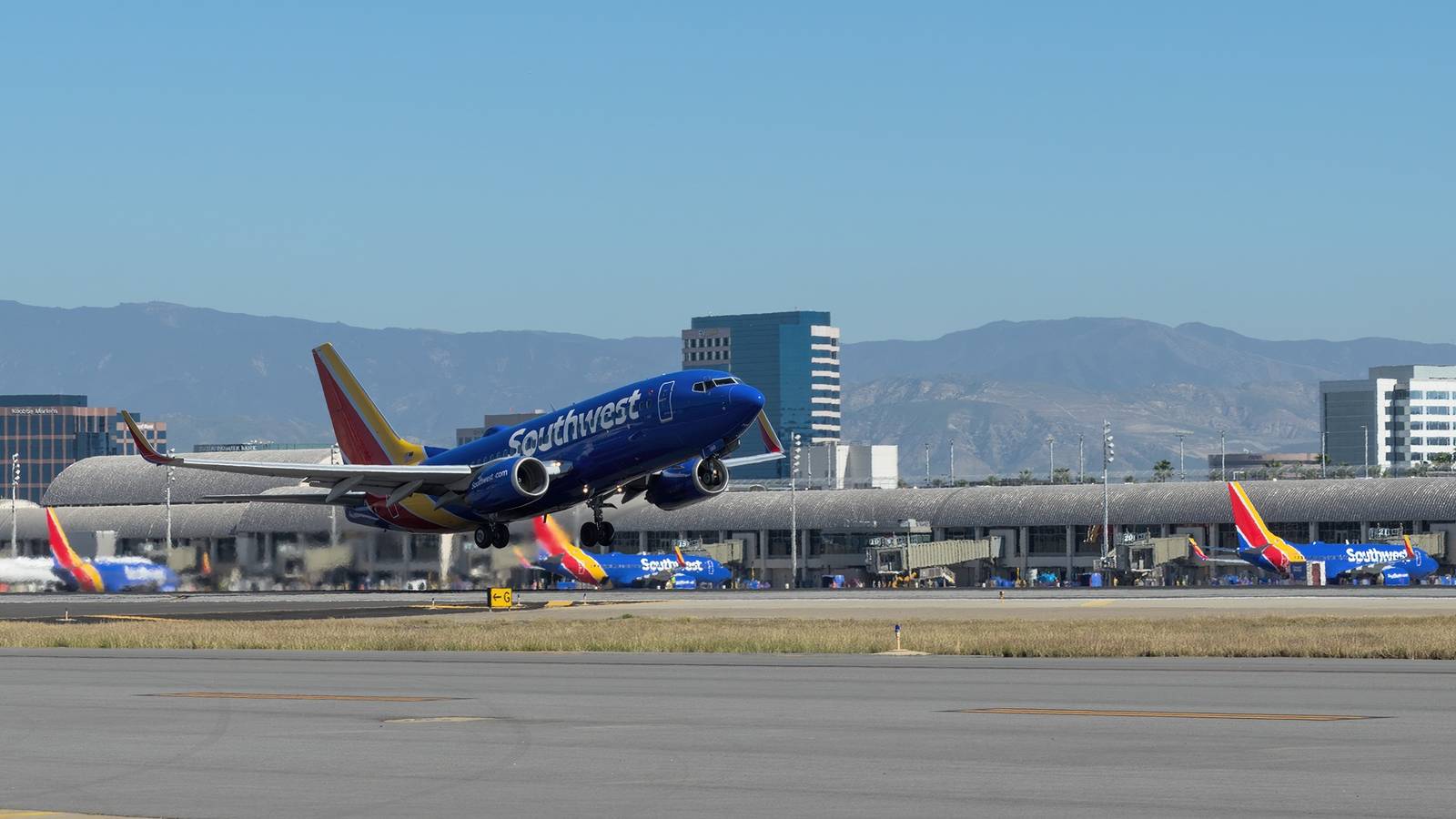
A 19-year-old Southwest Airlines Boeing 737 lost its #2 engine after takeoff and declared an emergency, according to a report by simpleflying.com. The incident occurred on November 6, 2026.
Journalist – Aaron is an aviation and travel journalist with 14 years of experience in the travel and tourism industry. His background spans airport operations, aviation infrastructure, and travel consulting, having worked with global organizations across New Zealand, Europe, and North America. Combining industry expertise with firsthand travel experience across more than 52 countries and five continents, Aaron covers airlines, airports, aviation policy, and the wider travel sector. He is based in Canterbury, New Zealand.
His work has been published in Simple Flying and featured by MSN, SAM CHUI Aviation & Travel, EIN News, Pakistan Defence, and Climate Depot.
A Southwest Airlines flight experienced an engine failure shortly after takeoff from John Wayne Airport-Orange County Airport (SNA) on Friday. This resulted in the 19-year-old Boeing 737-700 declaring an emergency and diverting to Los Angeles International Airport (LAX). The flight, onboard one of the country's largest airlines, stopped its climb and squawked 7700, the standard broadcast for a general emergency to air traffic control.
WN3396, was a scheduled service from SNA to Norman Y. Mineta San Jose International Airport (SJC), and during the emergency diverted to LAX, where the aircraft landed safely.
According to CodeThreeNews, the crew onboard confirmed to air traffic control that there were 97 souls onboard, and shortly after its departure from Santa Ana, the jet lost power to its #2 engine. The aircraft at the center of the incident carries registration N281WN and was the 500th Boeing 737 delivered to the airline. It has accumulated more than 19 years of active service for the Dallas-based operator.
Following the incident, the Federal Aviation Administration (FAA) released the following statement, obtained by the Los Angeles Times.
"Southwest Airlines Flight 3396 landed safely at Los Angeles International Airport around 12:25 p.m. local time after the crew reported an engine issue."
A Southwest spokesperson also confirmed the incident in a statement to Simple Flying on Friday.
"Southwest Airlines Flight 3396 diverted safely to Los Angeles International Airport after the Pilots received an engine-related maintenance indication while flying from John Wayne Airport to San Jose Mineta International Airport," they explained. "The Pilots followed established procedures and landed the aircraft uneventfully. We appreciate the professionalism of our Pilots and Flight Crew. Southwest will accommodate our Customers on another flights to San Jose. Nothing is more important to Southwest than the Safety of our Customers and Employees."
Reviewing data from the Simple Flying Flight Tracker, WN3396 was scheduled to depart from Santa Ana at 11:35, for a quick one-hour flight north to San Jose. The plane eventually pushed back from the gate at 11:49, 14 minutes behind schedule.
After taking off in a north-easterly direction, the plane quickly turned southwest after experiencing the engine issue, and the jet turned southwest toward Los Angeles South Bay. Flight data shows that the plane never flew higher than 5,000 feet (1,524 meters). After 18 minutes over the Pacific Ocean, the aircraft was cleared to land at LAX, touching down safely on Runway 25L at 12:28 after a total flight time of 38 minutes.
Emergency services met the aircraft on arrival, and passengers were eventually disembarked with no reports of injury. Affected travelers have since been reaccommodated onto a replacement flight which was set to depart at 1:13 PM.
After nearly two decades with Southwest, N281WN was delivered to the airline in June 2007 and carries the "500th WN 737" sticker on its fuselage. The jet is configured to carry 143 passengers in an all-economy-class layout. Southwest operates an all-Boeing 737 fleet, with around 270 737-700s in service, making it the world's largest operator of the type, according to ch-aviation.
If an aircraft engine fails on takeoff, the crew will use asymmetric