



































In the early 1950s, the dawn of corporate aviation in the United States was powered by surplus WWII airframes. Post-war prosperity sparked the rise of private aviation as businesses purchased aircraft like the Douglas DC-3 or Lockheed Lodestar and refitted them from bare-bones military transport into luxurious passenger planes. Cessna saw an opening in the market for a purpose-built business airliner and set to work designing what would become known as the Model 620.
Introduced as the 'billionaire's airliner,' the Cessna 620 was engineered with impressive specifications for its time. The plane's performance allowed it to carry passengers high above the weather in smooth skies while the well-appointed interior made the journey as much of an experience as the destination. Yet, the 620 never found a single buyer. Even more seriously, nothing about the airplane itself explains that fate.
What happened
Most aircraft that vanish after one prototype do so because something went wrong in the air, but the 620 offers no obvious defect. Test pilots praised it, and people inside the company regarded it as one of the more successful development efforts Cessna had ever undertaken. The blame was assigned to factors outside the production line, in a market that was changing faster than any piston airplane could keep up with.
The detail
According to Plane and Pilot, the Twin Beech and the Howard 500 were among the few purpose-built executive types in production at the time.
The wider picture
These airplanes worked, but they were costly to operate and short on comfort. Cessna management approved a design in 1953 that would pair airliner comfort with the familiarity of a light twin. At the time, piston power dominated the segment because turbine engines remained expensive to develop and build.
What comes next
A larger airplane using proven piston technology was a safer bet for a winning formula. The company had good reason to feel confident. Its twin-engine 310 was a leader in a growing class of executive airplanes that included the Beechcraft Twin Bonanza and the Piper Apache.
Additional context
Still, Cessna was proposing something no light airplane maker had attempted: a pressurized cabin for high-altitude flying with four engines to carry it there. That ambition shaped everything that followed, from the airplane's size to its price, and it set up the first real dilemma in the program: how much airplane the corporate customer actually wanted, and how much that customer would pay for it.
Analysis
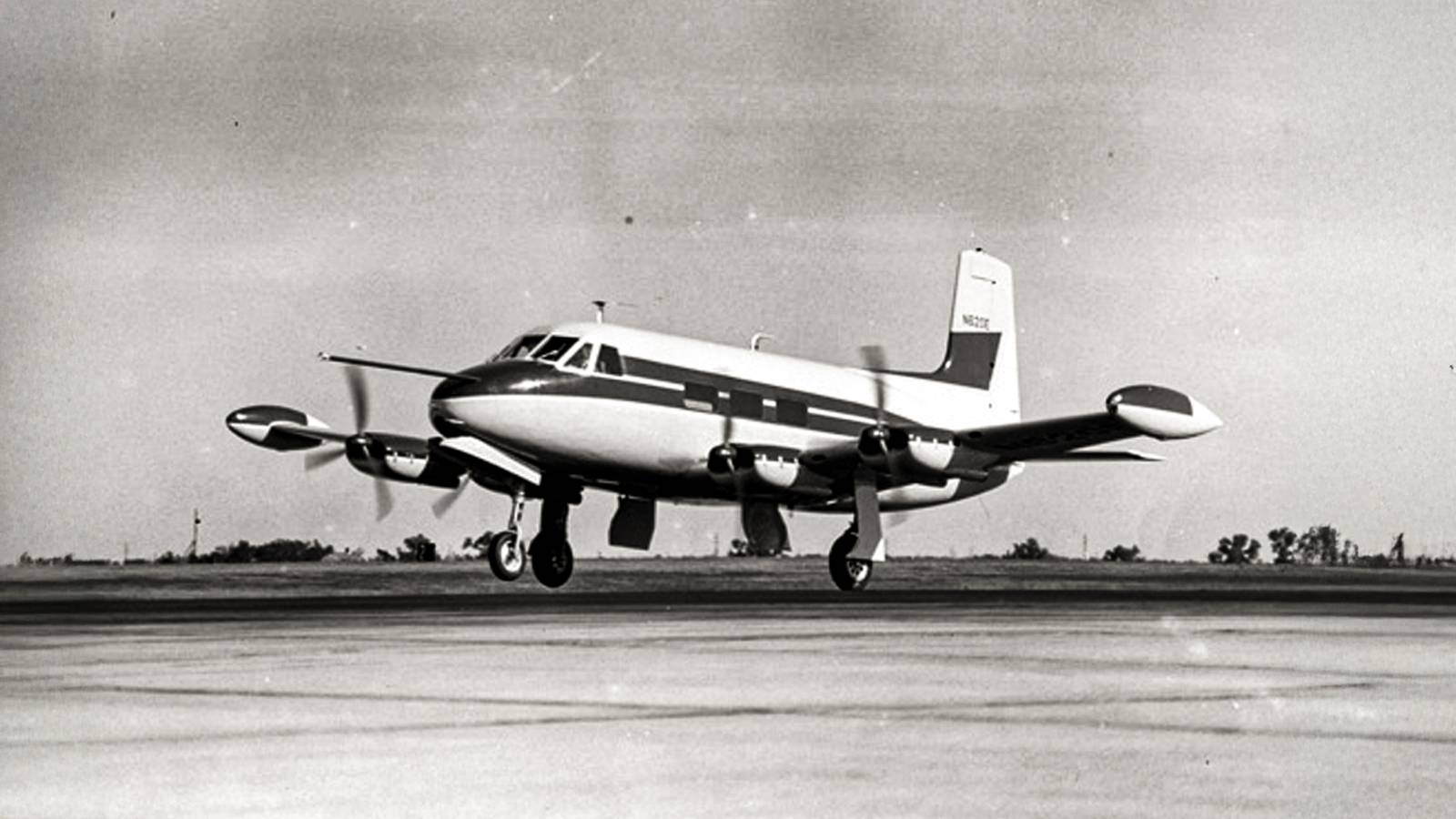
Designers gave the 620 the proportions of a small airliner while applying design principles of a light twin. Plane and Pilot likens it to a shrunken Douglas piston airliner with the wing and engine nacelles of the 310. Power came from four Continental six-cylinder engines of 350 horsepower each, a combination that avionslegendaires. net says gave the airplane a record power level at the time.
Reactions
Cessna flew the finished prototype, registered N620E, on August 11, 1956, before sending it around the country on a publicity tour. It reportedly featured a service ceiling above 20,000 feet (6,096 meters), an auxiliary power unit to cool the cabin on the ground, and cruise near 260 knots with a range beyond 1,700 nautical miles (3,148 km).
Developments
The flight controls needed no hydraulic boost, and test pilots described a roomy cockpit with gentle handling. For an executive airplane of the mid-1950s, that was a serious package. By those measures, the 620 delivered what Cessna had promised, and designers and test pilots counted it among the company's most successful designs.
Developments · 2
That is the strongest evidence that nothing was wrong with the airplane. Instead, the first weakness showed up in the price. Aerokurier reported that the base figure of $375,000 excluded avionics and wing deicing equipment, both items that serious corporate operators would have considered essential. The real cost of a useful 620 would therefore have climbed too high for the market of the time.
Developments · 3
Cabin size cut both ways. Executives wanted comfort, but a bigger airplane carries higher operating costs. Any company flight department that bought a 620 would have had to justify four engines to maintain the added fuel consumption, and a crew qualified on a complex pressurized type. The same features that made the airplane attractive also made it expensive to own on top of the high flyaway purchase price.
Developments · 4
Cessna was asking buyers to adopt something new at once with the 620 in a market where customers tend to be conservative with investments. Historical analysts argue that many business aviation customers of the period were cautious about novelty designs and chose to stick with the tried and true platforms that had been battle-tested in the fires of WWII.
Developments · 5
Pressure came from investors as well. Retrospectives hold that shareholders did not see a major prospect for profit in the 620, and company leaders themselves regarded the piston engines as a stopgap, with turboprops already in the works for follow-on developments. A program built around an engine its own makers viewed as temporary carried an expiry date. It did not bode well for a plane that would soon face far stiffer competition since the arrival of the jet age.
Developments · 6
The imminent arrival of the North American Sabreliner and the Grumman Gulfstream I created a technological pincer movement in the late 1950s that effectively destroyed the commercial viability of the Cessna 620 before it could even enter production. Meanwhile, surplus piston airliners kept the bargain end of the market crowded. Each rival attacked a different weakness in the 620, and none of them would be answered in time.
Developments · 7
North American Aviation approached the corporate market from the high-speed end of the spectrum, developing a twin-jet platform that would soon become known as the Sabreliner. Drawing heavily from the swept-wing aerodynamics of the legendary F-86 Sabre fighter, this clean-sheet design offered speed and altitude capabilities that no piston-driven aircraft could match. Furthermore, the financial risk of the program was heavily mitigated when the US Air Force selected the design for its Utility Trainer Experimental program, ordering it into production as the T-39.
Developments · 8
Grumman Aircraft Engineering tailored a solution specifically for the corporate boardroom with the Gulfstream I. The Gulfstream I offered a significantly wider, more cavernous cabin than the Cessna 620, allowing executives to stand up and walk around freely during flight. It established a prestigious new standard for corporate luxury. The twin-turboprop was powered by the Rolls-Royce Dart engine. This choice provided an optimal compromise for the era, delivering smooth, vibration-free comfort alongside exceptional short-field performance and fuel efficiency.
Developments · 9
Companies that prioritized raw speed and military-grade reliability lined up for the Sabreliner, while those seeking cabin space, transcontinental range, and operational flexibility chose the Gulfstream I. The third pressure was a market flooded with used airplanes. Faced with this landscape, the executive market quickly evaporated for Cessna's prototype.
Developments · 10
The unique Cessna 620 prototype met a definitive and unceremonious end shortly after its sudden cancellation in the autumn of 1957, roughly 14 months after the prototype first flew. The company turned its attention elsewhere, and the 620 moved from the front of the company's plans to a footnote. The result was an unusually complete disappearance. No airframe survives in a museum, and the 620 appears in few histories of Cessna beyond brief mentions.
Local impactFollow how this story develops and what it means for you.
Source: The 4-Engine Cessna Business Airliner That Met Its Design Goals, Then Was Canceled 14 Months After 1st Flight (simpleflying.com) · Oct 23, 2026
What to do next
- Read more about this topic on LYVGO.
- See related stories from the same desk.
- Follow this developing story for the latest updates.
Comments